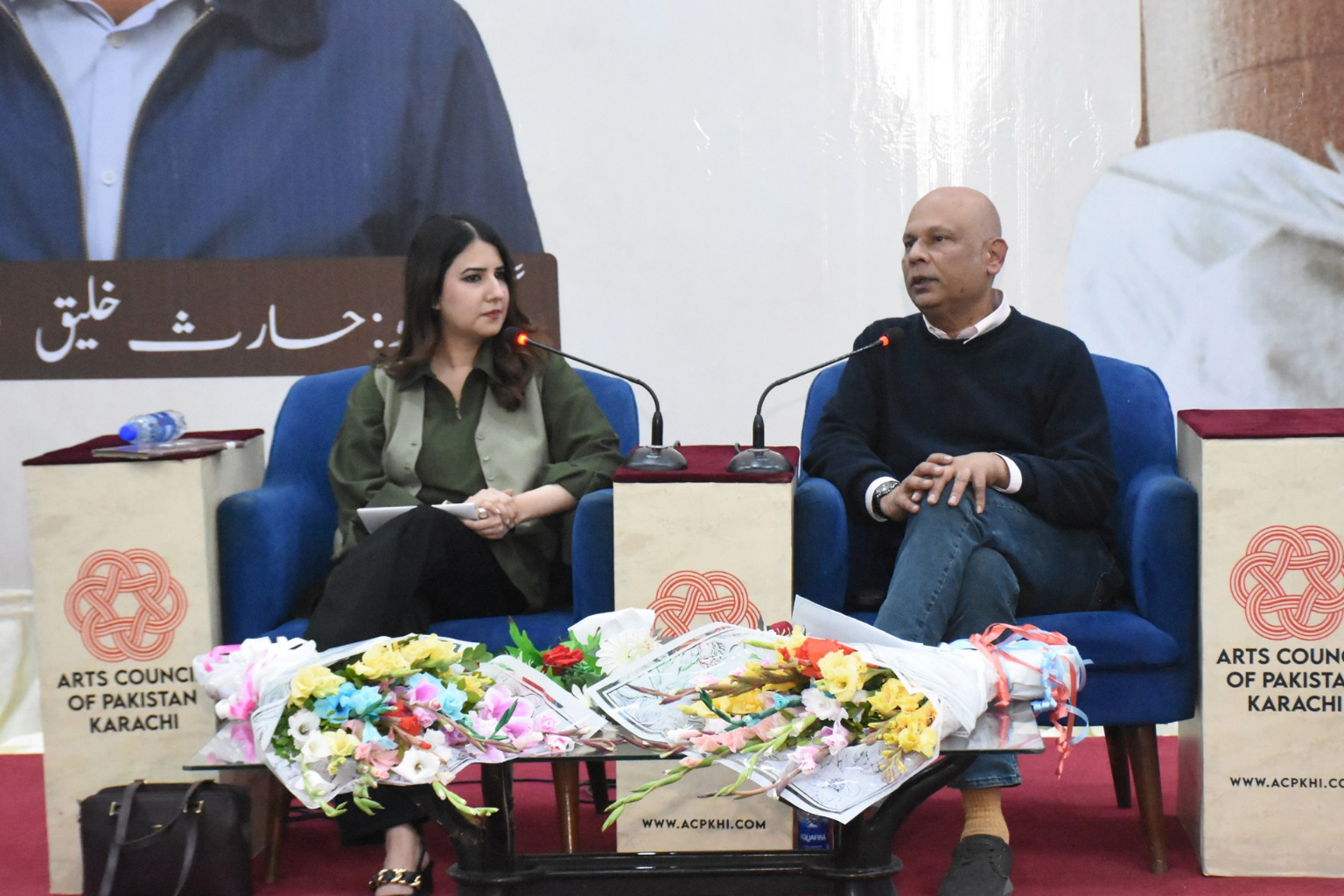
Karachi: Arts Council Pakistan Karachi organized a special panel discussion titled “Manto and Today’s World” on the occasion of the anniversary of renowned Urdu short story writer Saadat Hasan Manto at the Hasina Moin Hall. The session featured a detailed talk by human rights activist and poet Haris Khaleeq, while well-known anchor and journalist Absa Komal served as the moderator.
The event was attended by President of Arts Council Muhammad Ahmed Shah, journalist Ghazi Salahuddin, writer Noor-ul-Huda Shah, Ayub Sheikh, Dr. Qaiser Sajjad, Sadiqa Salahuddin, and numerous other literary and social figures. During the ceremony, the Arts Council presented bouquets to Haris Khaleeq and Absa Komal. The session began with a discussion of letters written by Manto between 1951 and 1954.
Haris Khaleeq highlighted that Manto’s works lacked any rigid linearity, which distinguished him from other prominent writers of his time. He noted that the literary scene during Manto’s era was sharply divided, with right- and left-leaning writers often at odds. Manto, however, maintained a unique perspective, viewing India and Pakistan on an equal footing and giving voice to marginalized communities in their own language. Khaleeq emphasized that the global trends of the 1950s and 1960s still resonate today, despite technological advancements, and that human traits like vulnerability and joy remain constant.
He added that Manto was aware of the unfinished process of partition in 1947 and warned against oversimplifying historical narratives. According to Khaleeq, power and influence in the West should not be conflated with the general public, as there have always been diverse voices challenging mainstream narratives. He stressed the need to reconnect laborers, writers, and journalists on a global level, asserting that while states perform their duties, society often moves ahead.
Absa Komal reflected on Manto’s timeless insights, citing his statement, “I am poor because my country is poor.” She noted that despite modern advancements, this truth remains relevant as population growth and employment challenges persist. Komal concluded that Manto’s legacy provides a model for writers today, particularly in addressing narrow-minded social norms, and emphasized that Manto’s perspective transcended religion, focusing instead on humanity