

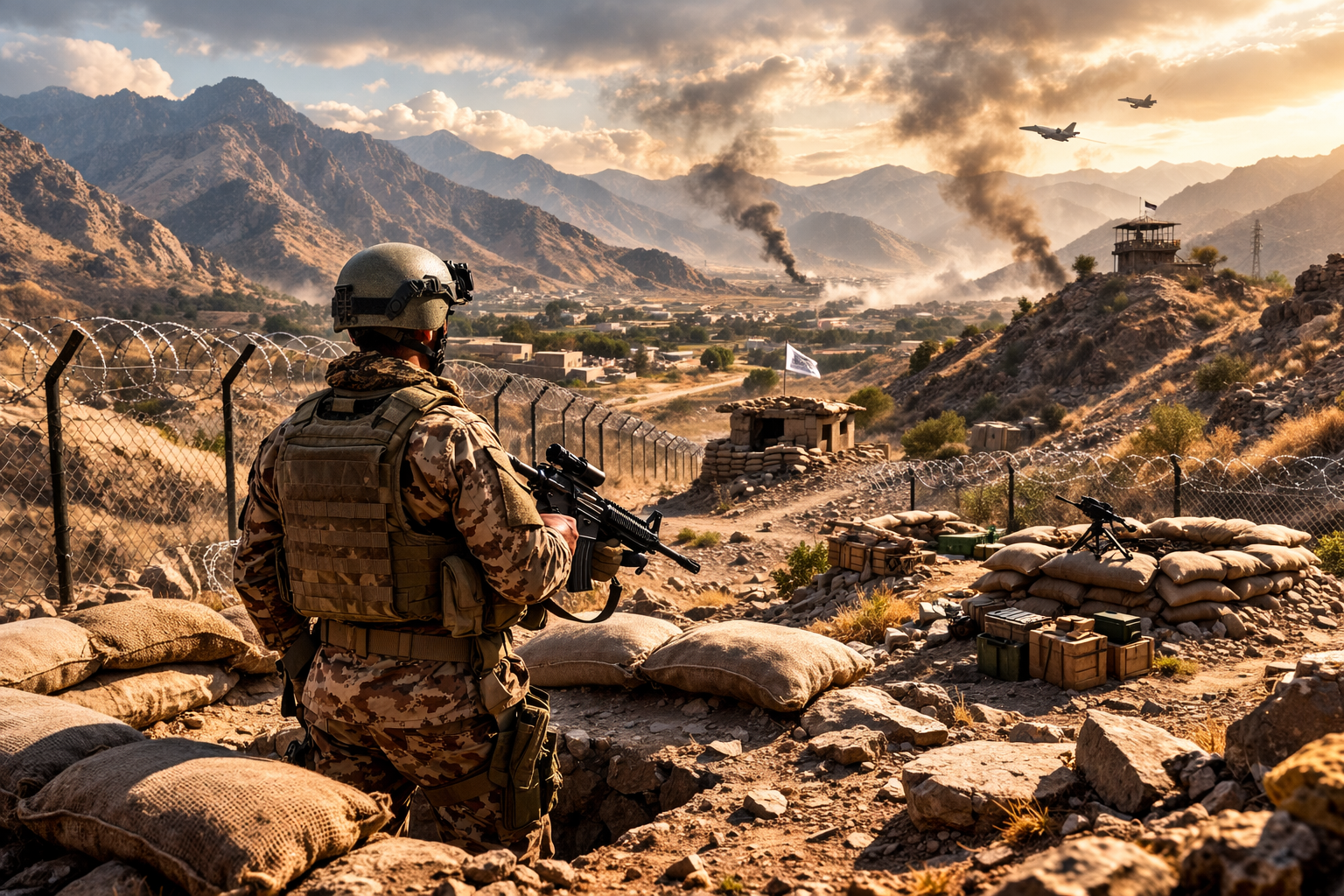
Pakistan airstrikes Afghanistan 80 terrorists in a major cross-border operation targeting militant camps linked to recent suicide bombings inside Pakistan, according to a senior security source.
Officials confirmed that more than 80 militants were killed in overnight strikes along the Pakistan-Afghanistan border. The toll may rise as damage assessments continue.
The Ministry of Information and Broadcasting said the operation targeted seven terrorist camps belonging to the banned Tehreek-i-Taliban Pakistan (TTP) — referred to by the state as Fitna al Khawarij — and affiliates of Islamic State – Khorasan Province (ISKP).
Authorities described the action as a “retributive response” to recent deadly attacks across Pakistan.
Pakistan Airstrikes Afghanistan 80 Terrorists After Suicide Attacks
The operation followed a wave of suicide bombings in Islamabad, Bajaur, and Bannu during the holy month of Ramazan.
Among the major incidents:
- Suicide attack at an Imam Bargah in Islamabad
- Vehicle-borne blast at Malangi check post in Bajaur
- Suicide bombing during an intelligence-based operation in Bannu
Officials said intelligence reports confirmed that Afghanistan-based handlers directed these attacks.
The government stated that Pakistan had “conclusive evidence” linking the assaults to leadership operating from Afghan soil.
According to the statement, the strikes were:
- Intelligence-based
- Selectively targeted
- Focused on verified militant hideouts
- Designed to avoid civilian harm
ALSO READ
145 Terrorists Killed in 40 Hours as CM Bugti Vows to Defeat Terrorism in Balochistan
Official Statement and International Message
The government said Pakistan remains committed to regional peace. However, it stressed that national security remains its top priority.
Officials urged the Afghan interim administration to fulfill its obligations under the Doha Agreement, which requires Afghan territory not to be used against other countries.
Pakistan also called on the international community to ensure compliance with global counterterrorism commitments. Recent assessments by the United Nations Security Council indicate that ISKP continues to pose a regional threat. Likewise, the US State Department Country Reports on Terrorism highlight the persistent challenge of cross-border militant networks operating in the region
The government said Pakistan remains committed to regional peace. However, it stressed that national security comes first.
Officials urged the Afghan interim government to fulfill its obligations under the Doha Agreement, which requires Afghan territory not to be used against other countries.
Pakistan also called on the international community to press the Afghan Taliban regime to prevent cross-border terrorism.
Political Reaction
Parliamentary Affairs Minister Tariq Fazal Chaudhry said the Pakistan Air Force carried out the strikes.
He called the action a response to the “innocent lives lost to terrorism.”
He warned that while Pakistan seeks peace, it will not compromise on sovereignty or citizen safety.
Earlier, Defence Minister Khawaja Asif had publicly stated that Pakistan would strike militant sanctuaries inside Afghanistan if attacks continued.
Timeline of Escalation
October 11–12, 2025
Border clashes erupt along the Pak-Afghan border.
November 2025
Afghan authorities claim Pakistan carried out airstrikes in Khost, Kunar, and Paktika.
February 16, 2026
Vehicle-borne suicide bombing in Bajaur kills 11 soldiers.
February 19, 2026
Pakistan signals possible cross-border military action.
February 21, 2026
Suicide attack in Bannu kills a lieutenant colonel and a sepoy.
Latest Development
Pakistan airstrikes Afghanistan 80 terrorists in coordinated operation.
Background: Rising Tensions Since 2021
Tensions have escalated since the Afghan Taliban returned to power in Kabul in 2021.
Islamabad has repeatedly urged Kabul to dismantle sanctuaries used by the TTP.
However, Pakistani officials say those appeals produced no measurable results.
Security analysts note that ISKP has also expanded its operational footprint in border regions.
Analysis: Strategic Significance of Pakistan Airstrikes Afghanistan 80 Terrorists
The operation marks one of the most direct cross-border responses in recent months.
Strategically, it signals:
- Shift from diplomatic pressure to kinetic action
- Escalation in cross-border counterterrorism strategy
- Warning to militant leadership operating outside Pakistan
However, experts caution that such strikes may strain diplomatic relations further.
Pakistan faces a balancing act between national security and regional stability.
Why This Matters
- Terror attacks have intensified in Khyber Pakhtunkhwa.
- Cross-border militancy remains a core security challenge.
- The strikes may reshape Pakistan-Afghanistan relations.
- International attention on regional counterterrorism may increase.
The safety of civilians and soldiers remains the central concern.
What Happens Next
Security operations are expected to continue.
Pakistan may increase border surveillance and intelligence coordination.
Diplomatic engagement with Kabul could intensify.
International stakeholders may also intervene to reduce escalation.
Further casualty verification is underway.
FAQs
1. Why did Pakistan conduct the airstrikes?
Authorities say the strikes targeted militant camps responsible for recent suicide bombings.
2. How many militants were killed?
Officials report more than 80 terrorists were killed. The number may rise.
3. Which groups were targeted?
The operation targeted TTP (Fitna al Khawarij) and ISKP affiliates.
4. Were civilians harmed?
Officials state the operation involved intelligence-based selective targeting to avoid civilian casualties.
5. Could tensions escalate further?
Security analysts say diplomatic channels remain open, but tensions may increase.
