

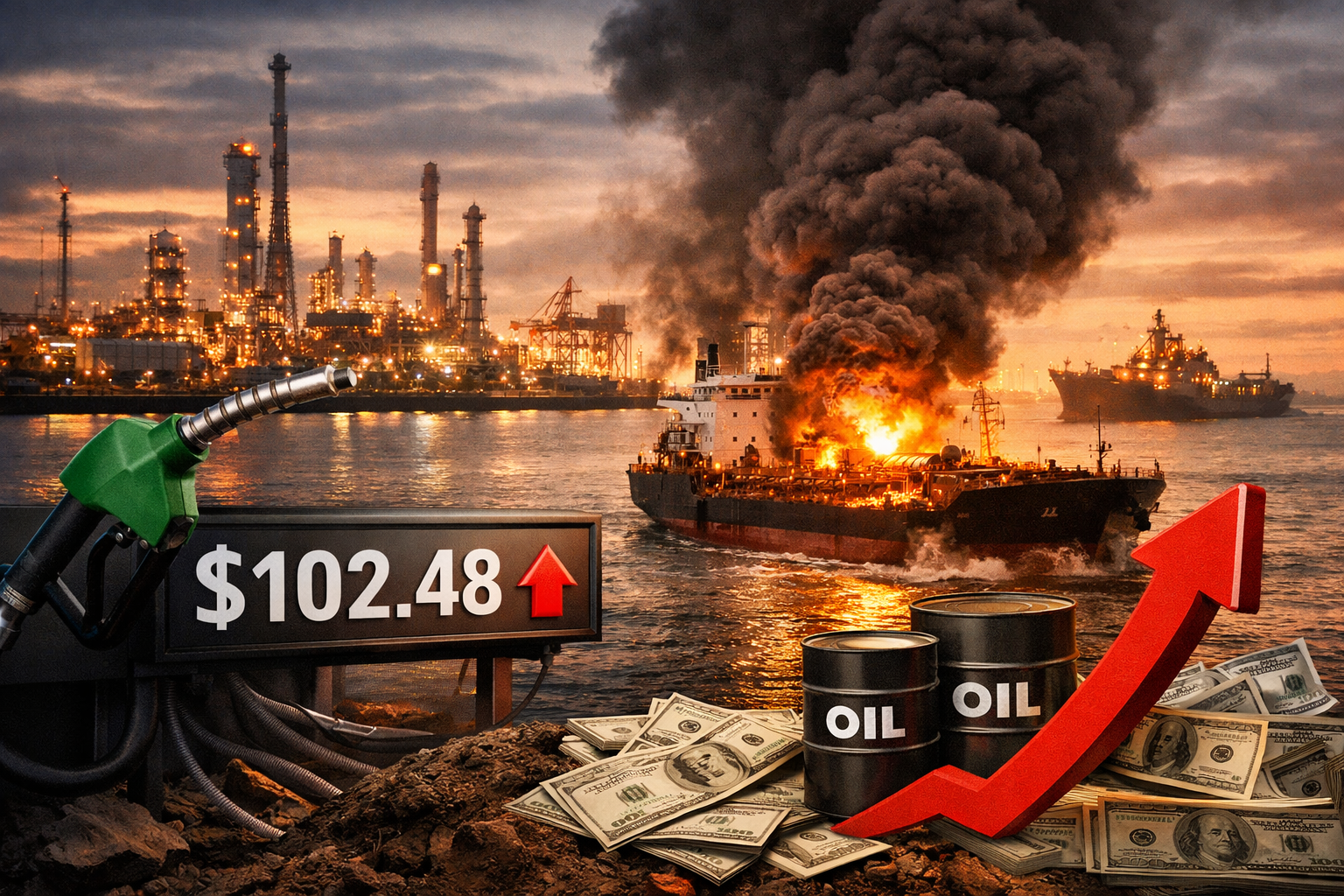
Global oil prices jumped sharply on Thursday, climbing back above $100 a barrel as renewed attacks on cargo vessels in the Gulf raised fears of major supply disruptions. The surge came despite the International Energy Agency announcing a record release of oil reserves to stabilise global markets amid the ongoing conflict involving the United States, Israel and Iran.
Benchmark Brent crude rose by more than 9% during trading before easing slightly to around $97.90 a barrel, according to market data.
Investors remain concerned that continued attacks on shipping and energy infrastructure around the Strait of Hormuz could prolong instability in global energy markets.
Oil Prices Jump After Attacks on Shipping in the Gulf
The latest oil prices jump followed reports that three additional cargo vessels were struck in the Gulf, further escalating concerns about the safety of shipping routes.
The Strait of Hormuz is one of the world’s most critical energy corridors, handling a significant share of global oil and liquefied natural gas shipments.
Due to security concerns, the waterway has effectively been closed to commercial shipping, disrupting energy supply chains.
An official spokesperson for the Islamic Revolutionary Guard Corps warned that vessels connected to the United States, Israel, or their allies could be targeted.
“You will not be able to artificially lower the price of oil. Expect oil at $200 per barrel,” the spokesperson said.
“The price of oil depends on regional security, and you are the main source of insecurity in the region.”
IEA Oil Reserves Release Fails to Stop Oil Prices Jump
The oil prices jump occurred despite an unprecedented move by the International Energy Agency to release emergency reserves.
The agency announced that its 32 member countries would release a combined 400 million barrels of oil, the largest coordinated release in the history of global energy markets.
The IEA said the Middle East conflict was “creating the largest supply disruption in the history of the global oil market”.
According to the agency, major producers including Iraq, Qatar, Kuwait, the United Arab Emirates and Saudi Arabia have reduced oil production by at least 10 million barrels per day due to security concerns and operational disruptions.
Officials warned that restoring production could take weeks or even months.
Global Markets React as Oil Prices Jump
Financial markets reacted negatively as the oil prices jump raised fears about global economic recovery.
Stock markets across Europe declined during early trading.
- London’s FTSE 100 dropped 0.6%
- Germany’s DAX index fell
- France’s CAC 40 and Spain’s IBEX also slipped
In Asia, Japan’s Nikkei 225 closed down around 1%.
Energy analysts say the release of emergency reserves had already been expected by markets.
Bill Farren-Price from the Oxford Institute for Energy Studies said the move was largely priced into oil markets.
“It is a sticking plaster on a much bigger problem,” he told BBC radio.
“We are losing about 20 million barrels a day of supply from the Gulf, and while 400 million barrels is significant, the global market consumes more than 100 million barrels per day.”
Asia Feels Impact of Rising Energy Costs
The impact of the oil prices jump is already being felt in several Asian economies that rely heavily on Middle Eastern energy supplies.
Long queues have formed at petrol stations in countries including the Philippines, Thailand and Vietnam as motorists rush to secure fuel.
Authorities in Thailand have urged government agencies to adopt remote working policies to reduce energy consumption.
Meanwhile, the Philippines has introduced a four-day work week for government employees to help conserve fuel and electricity.
Economic Concerns as Energy Prices Rise
Oil markets have been highly volatile since airstrikes by the United States and Israel targeted sites in Iran on 28 February.
Before the conflict began, Brent crude was trading near $73 a barrel. Earlier this week it approached $120.
Economists warn that rising energy costs could drive global inflation higher and delay interest rate cuts expected by central banks.
In the United Kingdom, the Bank of England is due to review interest rates next week. The benchmark rate currently stands at 3.75%.
Some analysts say the bank may now delay previously expected rate cuts.
Maike Currie, head of personal finance at PensionBee, said market expectations had shifted significantly.
“We were expecting two interest rate cuts this year, now we’re expecting none and there’s even the possibility of rate rises,” she said.
Outlook as Energy Markets Remain Unstable
Analysts say oil markets are likely to remain volatile as long as security concerns persist around the Gulf’s critical shipping routes.
Traders continue to monitor geopolitical developments and energy infrastructure in the region, which could determine whether global supply disruptions ease or intensify in the coming weeks.
