

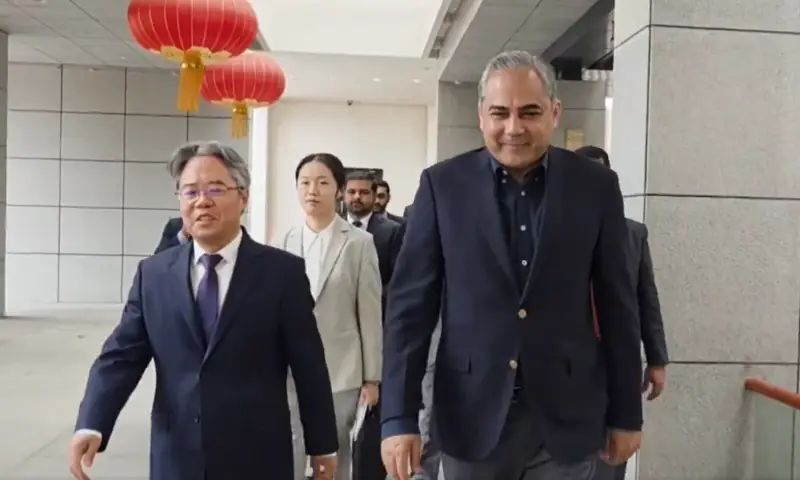
Mohsin Naqvi China security cooperation talks took centre stage on Friday as Interior Minister Mohsin Naqvi met Chinese Ambassador Jiang Zedong at the Chinese Embassy in Islamabad, where the two sides discussed counter-terrorism measures, the Police Exchange Programme, and the broader regional security situation.
The Interior Ministry confirmed the meeting through an official social media post, sharing video footage of Naqvi being received by Ambassador Jiang at the embassy entrance in Islamabad’s Diplomatic Enclave. The discussions reflected growing bilateral urgency around the safety of Chinese nationals and investors operating across Pakistan.
Mohsin Naqvi China Security Cooperation Covers Counter-Terrorism and Police Exchange
Mohsin Naqvi China security cooperation deliberations at Friday’s meeting addressed the full spectrum of bilateral security concerns, with counter-terrorism topping the agenda. Officials said the two sides reviewed existing mechanisms and explored ways to strengthen joint efforts against militant threats that have previously targeted Chinese personnel and infrastructure in Pakistan.
The Police Exchange Programme — a bilateral initiative designed to enhance law enforcement capacity through shared training and institutional knowledge — was also discussed in detail. Pakistan and China have previously used such frameworks to align policing standards and improve coordination on cross-border security matters.
“Discussion on the overall situation of the region also took place in the meeting,” the Interior Ministry said in its official statement, signalling that the talks extended beyond bilateral issues to encompass the wider geopolitical environment, including ongoing tensions in the Middle East.
Business Conference Planned to Address Security of Chinese Investors
One of the most significant outcomes of the Mohsin Naqvi China security cooperation meeting was the decision to convene a dedicated business conference focused on the security concerns of Chinese investors operating in Pakistan. Officials said the conference will be structured in two phases.
In the first phase, meetings will be held with members of the Chinese business community already present and operating in Pakistan. The second phase will bring in Chinese investors and companies that are considering entering the Pakistani market, allowing security concerns to be addressed proactively before investments are committed.
The initiative reflects a broader Pakistani government effort to reassure Chinese partners that their personnel and assets will be protected at a time when Beijing has repeatedly raised concerns over the security of Chinese nationals involved in infrastructure and energy projects across the country, particularly those linked to the China-Pakistan Economic Corridor.
Special Protection Unit to Be Established for Chinese Nationals in Islamabad
A key announcement to emerge from Friday’s discussions was the establishment of a dedicated Special Protection Unit for foreign citizens in Islamabad, with an initial focus on the security of Chinese nationals in the capital. Interior Minister Naqvi confirmed the unit is being set up and will operate with a specific mandate to ensure the safety of Chinese citizens residing and working in Islamabad.
In a notable operational detail, officials of the Special Protection Unit will receive Chinese language training as part of their formal preparation, according to Mushtaq Cheema. The language component is intended to improve direct communication between security personnel and the Chinese nationals they are assigned to protect, reducing response delays in security-critical situations.
The announcement signals a significant institutional upgrade in Pakistan’s approach to protecting Chinese nationals, moving beyond ad hoc arrangements toward a structured, dedicated security architecture for foreign citizens.
Chinese Ambassador Meets PM Shehbaz a Day Earlier
Friday’s Mohsin Naqvi China security cooperation meeting came one day after Ambassador Jiang Zedong held a separate high-level engagement at the Prime Minister’s House, where he called on Prime Minister Shehbaz Sharif. Deputy Prime Minister and Foreign Minister Ishaq Dar, Special Assistant to the Prime Minister Syed Tariq Fatemi, and the Foreign Secretary were also present at that meeting.
During the PM-level discussion, Prime Minister Shehbaz highlighted Pakistan’s constructive role in promoting de-escalation and regional stability, particularly in the context of the ongoing conflict in the Middle East. The back-to-back engagements — at the PM House on Thursday and the Interior Ministry level on Friday — underline the intensity of current Pakistan-China diplomatic consultations.
Also on Tuesday, Chinese Consul General Sun Yan met with Punjab Home Secretary Dr Ahmad Javed Qazi in a separate session focused on law and order in the province, with particular attention to security arrangements for Chinese nationals working on projects across Punjab.
Background: China-Pakistan Security Relations Under Pressure
Pakistan-China security cooperation has faced sustained pressure in recent years following a series of attacks targeting Chinese engineers, workers, and diplomatic personnel. The March 2024 suicide bombing at Bisham in Khyber Pakhtunkhwa, which killed five Chinese engineers, drew sharp concern from Beijing and prompted Pakistan to undertake a comprehensive review of its security protocols for Chinese nationals.
China has made the protection of its citizens a recurring diplomatic priority in its engagement with Islamabad, conditioning deeper investment commitments in part on demonstrable improvements in security arrangements. Pakistan has responded with a series of institutional measures, including the expansion of dedicated security details for CPEC project sites.
According to Reuters, China remains Pakistan’s largest bilateral investor and a critical partner in infrastructure development, making the security of Chinese personnel a matter with direct implications for the country’s economic trajectory.
The latest round of engagements, spanning the prime ministerial, interior ministry, and consular levels within a single week, suggests both governments are treating the security cooperation agenda with renewed urgency as regional tensions continue to evolve.
