

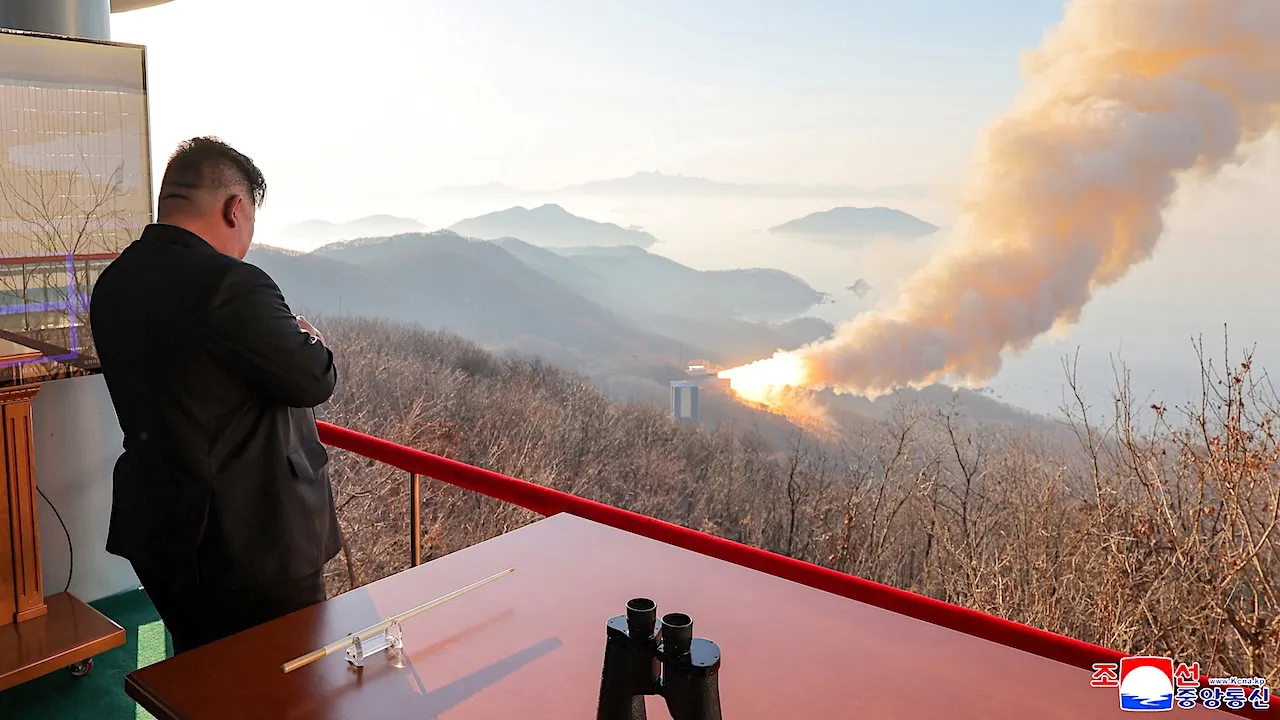
North Korea missile test latest saw Kim Jong Un oversee a ground test of an advanced high‑thrust solid‑fuel rocket engine designed to strengthen the regime’s strategic strike capability, including potential for weapons capable of reaching the U.S. mainland, state media reported Sunday.
The engine, built with lightweight carbon‑fibre materials, reportedly delivered about 2,500 kilonewtons of thrust, up from roughly 1,971 kN in a similar test last year — a key step in Pyongyang’s ongoing effort to modernize its long‑range missile arsenal under a new five‑year defense plan.
Table of Contents
North Korea Missile Test Latest: Solid‑Fuel Engine Test Signals Strategic Missile Push
State news outlet KCNA said the test was part of North Korea’s drive to enhance its “strategic strike” capabilities, underscoring Pyongyang’s focus on more mobile, responsive missile systems that can be deployed with less warning than traditional liquid‑fuel rockets.
Solid‑fuel systems are prized in modern missile design because they can be launched more rapidly and are harder for adversaries to detect or preempt, theoretically enhancing survivability in any future conflict.
Credit for the test was given to Kim Jong Un, who declared it had “great significance in putting the country’s strategic military muscle on the highest level.”
What the New Engine Means for North Korea’s ICBM Ambitions
Analysts believe the high‑thrust solid‑fuel engine could form the propulsion core of future intercontinental ballistic missiles (ICBMs) — potentially enabling missiles that are quicker to launch, more mobile, and capable of carrying heavier or multiple warheads.
Such developments have troubled U.S. and allied officials, who note that solid‑fuel ICBM technology, if perfected, could reduce warning times and complicate missile defense.
However, external experts caution that despite North Korea’s claims, significant technical barriers remain, including ensuring a reliable warhead can survive atmospheric reentry — a key hurdle before a fully operational US‑targeting missile can be fielded.
Kim’s Broader Military Drive
The engine test was accompanied by state coverage of Kim inspecting special operations training and a new main battle tank, part of a broader effort to modernize both strategic and conventional forces amid mounting geopolitical tensions.
North Korea’s ongoing weapons push coincides with defiant rhetoric blaming the United States and its allies for regional instability while reaffirming Pyongyang’s intention to cement its status as a nuclear power.
Recent photos released by state outlets also show Kim observing the engine test with senior officials, a sign of the regime’s eagerness to showcase its advancements to domestic and international audiences.
Regional and Global Reactions
Governments in South Korea, Japan, and the United States confirmed they are closely monitoring Pyongyang’s weapons developments, emphasizing the implications for regional security and global non‑proliferation efforts.
Tokyo’s defense ministry has repeated concerns that more advanced solid‑fuel missiles would complicate detection and defense, while Washington has urged Pyongyang to return to diplomatic negotiations to reduce tensions.
Background: North Korea’s Strategic Forces
North Korea’s Strategic Force, a dedicated branch of the Korean People’s Army, manages the country’s ballistic missile arsenal including long‑range systems.
The regime has conducted a series of missile tests in recent years, steadily advancing propulsion technology and launch readiness, reflecting its prioritization of strategic deterrence amid heavy international sanctions.
Outlook: What Comes Next
Experts say that while this test represents a technical milestone, Pyongyang will likely continue incremental advances in missile technology — including further solid‑fuel engine development and potential incorporation of multiple independently targetable reentry vehicles (MIRVs) to counter missile defenses.
Efforts by the United States and allies to pressure North Korea through sanctions and diplomatic channels will persist, but analysts caution that without meaningful dialogue, Pyongyang’s weapons programs may remain a central flashpoint in East Asian security dynamics.
