

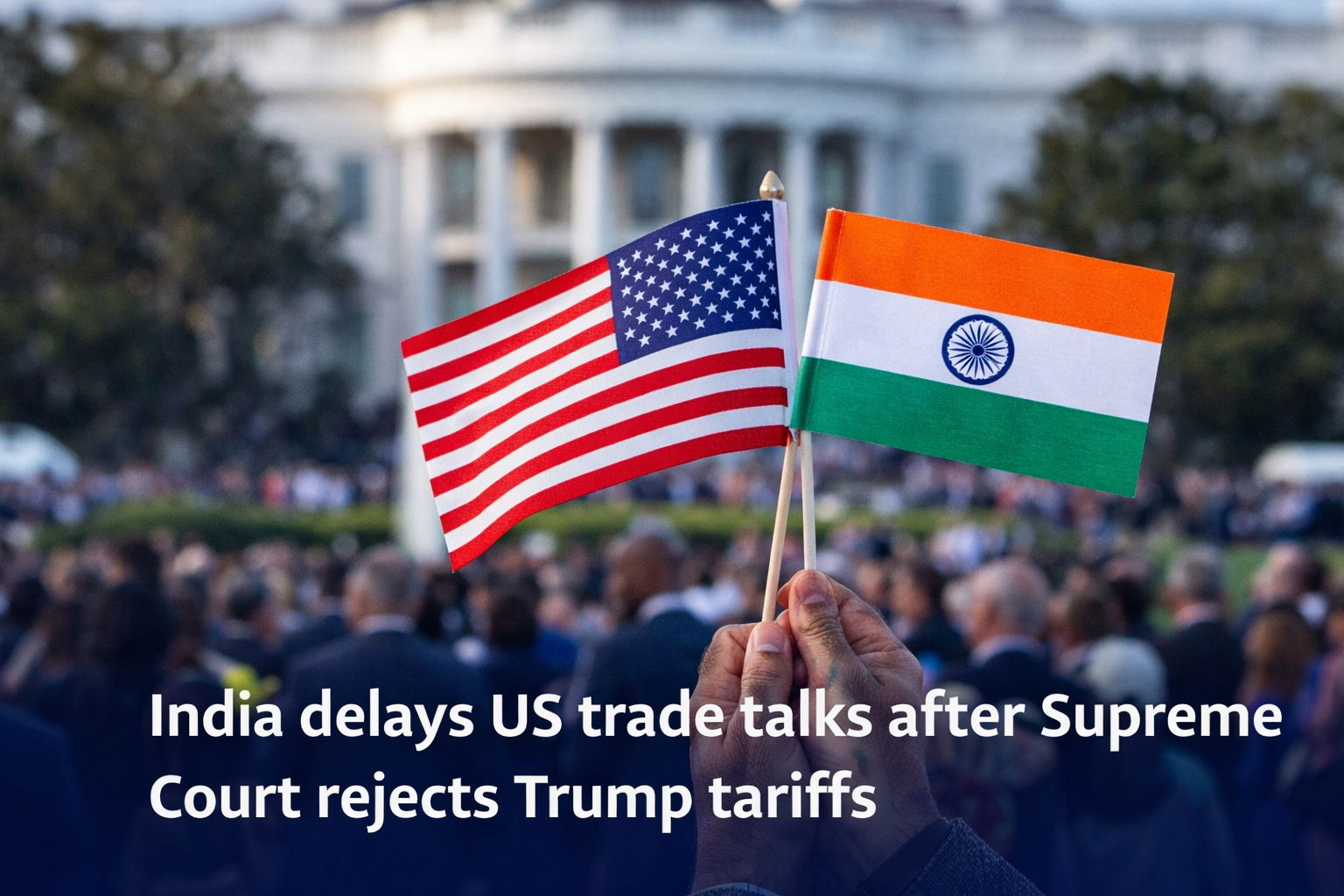
India delays US trade talks following a dramatic ruling by the United States Supreme Court that struck down tariffs imposed by President Donald Trump, triggering fresh uncertainty in global trade dynamics and temporarily halting momentum toward a major interim trade pact between Washington and New Delhi.
According to a senior source within India’s trade ministry, New Delhi has deferred plans to send a high-level trade delegation to Washington this week. The visit was intended to finalize critical aspects of an interim trade agreement that both countries had been negotiating for months.
Tariff Uncertainty Disrupts Negotiations
The decision to postpone the delegation’s visit comes primarily due to uncertainty surrounding US tariff policy after Friday’s Supreme Court ruling. The court invalidated tariffs previously imposed under Trump’s administration, creating immediate ambiguity over the legal and economic framework governing US imports.
In response to the court’s judgment, Trump announced on Saturday a temporary 15% tariff on imports from all countries — the maximum allowed under existing legal provisions. This rapid policy shift further complicated the trade landscape.
“The decision to defer the visit was taken after discussions between officials of the two countries,” the source said, requesting anonymity due to the sensitivity of the matter. “No new date for the visit has been decided.”
The move represents one of the first concrete reactions among Asian economies to the ruling, underlining how closely regional powers are watching developments in US trade policy.
READ ALSO: Trump global tariff vow triggers 10% global tariff
Interim Trade Deal at Stake
The delayed talks were expected to finalize an interim trade framework under which the United States would reduce punitive tariffs of 25% on selected Indian exports. These tariffs had been linked to India’s continued purchases of Russian oil.
Under the proposed arrangement:
- US tariffs on certain Indian goods would be reduced to 18%.
- India would commit to purchasing US goods worth approximately $500 billion over five years.
- The purchases would include energy supplies, aircraft, defense equipment, precious metals, and technology products.
The framework was viewed as a significant step toward stabilizing bilateral trade relations and laying the groundwork for a broader comprehensive trade agreement.
Political Reaction in India
The development has also sparked political debate within India. The opposition Congress party called for the interim pact to be put on hold and urged renegotiation.
Congress leaders questioned Prime Minister Narendra Modi’s decision to issue a joint trade statement before the Supreme Court’s ruling was delivered, arguing that the evolving legal situation in the US warranted caution.
Meanwhile, India’s trade ministry confirmed on Saturday that it is studying the implications of the court judgment and subsequent US tariff announcements before proceeding further.
Broader Economic Implications
The postponement highlights the fragility of international trade negotiations amid shifting legal and political landscapes. The United States remains one of India’s largest trading partners, and both economies had been working toward resolving long-standing tariff disputes.
Last week, Trade Minister Piyush Goyal indicated that the interim agreement could potentially take effect in April, pending resolution of outstanding issues during the Washington visit. However, with the delegation now delayed, timelines appear uncertain.
For India, clarity on US tariff policy is crucial before committing to large-scale procurement agreements. For Washington, maintaining stability in trade partnerships is equally critical amid ongoing global economic volatility.
Strategic Context
The India-US trade relationship extends beyond economics. It encompasses strategic cooperation in defense, technology, and energy security. The proposed $500 billion procurement commitment was widely interpreted as part of a broader geopolitical alignment between the two democracies.
However, sudden judicial and executive developments in the US have introduced unpredictability into the equation.
While both sides continue diplomatic engagement, the absence of a confirmed new date for talks suggests caution is prevailing over speed.
For now, India delays US trade talks, signaling that policy stability remains a prerequisite for moving forward with one of the most ambitious bilateral trade initiatives in recent years.
FAQs
1. Why did India delay US trade talks?
India delayed the talks due to uncertainty created after the US Supreme Court struck down Trump-era tariffs.
2. What was the interim trade deal about?
The deal included reduced US tariffs on Indian goods and India’s commitment to purchase $500 billion worth of US products over five years.
3. What triggered the tariff uncertainty?
The US Supreme Court rejected previous tariff measures, and former President Trump announced a temporary 15% tariff afterward.
4. Has a new date been set for the talks?
No, officials have not announced a new date for the postponed delegation visit.
5. How does this impact India-US relations?
The delay introduces short-term uncertainty but does not necessarily signal a breakdown in broader strategic cooperation.

One thought on “India Delays US Trade Talks After Supreme Court Rejects Trump Tariffs”