

Nearly five years after the Taliban’s return to power in Kabul, India has taken a decisive diplomatic step that signals a recalibration of its Afghanistan policy. In what analysts describe as a pragmatic shift, Kabul has appointed Noor Ahmad Noor as Chargé d’Affaires at the Afghan Embassy in New Delhi — the first Taliban-appointed envoy to India since 2021.
The development marks a visible milestone in India Taliban engagement, even though New Delhi has not formally recognized the Taliban government.
India’s evolving Afghanistan policy aligns with its broader regional strategy outlined by the Ministry of External Affairs, where stability, counter-terrorism cooperation and regional connectivity remain central pillars.
A Diplomatic Reset Amid Regional Friction
The renewed engagement comes at a time of escalating cross-border tensions between Afghanistan and Pakistan. Border clashes, militant accusations and retaliatory rhetoric have strained ties between Kabul and Islamabad to one of their lowest points in recent years.
India has expressed support for Afghan sovereignty while carefully avoiding direct military alignment. This positioning allows New Delhi to expand diplomatic space without crossing the threshold into formal recognition.
For decades, Pakistan sought what it termed “strategic depth” in Afghanistan. However, deteriorating trust between Kabul and Islamabad has opened space for India to cautiously re-enter the Afghan diplomatic landscape.
Strategic Calculations Behind India Taliban Engagement
Experts suggest that India’s outreach is rooted less in ideology and more in geopolitical realism.
By maintaining structured contact with Kabul, India aims to:
- Prevent anti-India militant activity from Afghan soil
- Counterbalance Pakistan’s traditional leverage
- Expand connectivity toward Central Asia
- Offset China’s growing footprint in the region
Afghanistan’s geography places it at the crossroads of major regional rivalries. With limited American involvement in day-to-day Afghan affairs, New Delhi appears confident in pursuing an India-centric Afghan strategy.
The possibility of renewed U.S. involvement — particularly amid past discussions by Donald Trump regarding strategic facilities like Bagram — adds another dimension to the evolving regional calculus. Policy positions from the U.S. Department of State continue to shape broader international engagement frameworks.
Humanitarian and Economic Dimensions
Beyond geopolitics, India’s role carries economic and humanitarian implications. Afghanistan remains heavily dependent on international assistance, with development and food security challenges persisting years after regime change.
India has provided wheat shipments, medical supplies, vaccines and infrastructure support as part of its engagement strategy. Broader humanitarian coordination efforts in Afghanistan continue under the supervision of the United Nations Assistance Mission in Afghanistan (UNAMA), which remains a key institutional presence in the country.
Such cooperation offers Kabul incremental diplomatic legitimacy while reinforcing India’s image as a regional stabilizer.
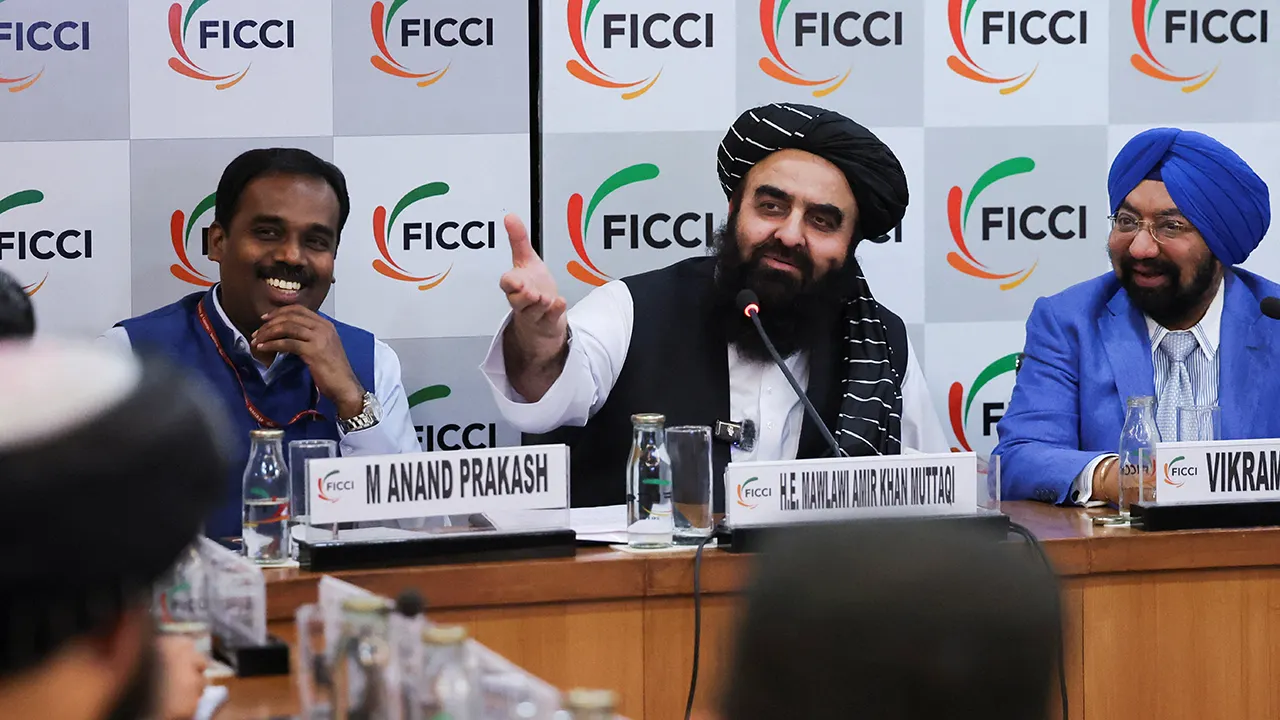
In October 2025, Afghanistan’s Foreign Minister Amir Khan Muttaqi participated in economic discussions in New Delhi, signaling that engagement has expanded beyond humanitarian channels into trade and private-sector dialogue.
Implications for Pakistan and China
Islamabad views deepening India Taliban engagement with caution. A more autonomous Kabul — less reliant on Pakistan — weakens Islamabad’s long-standing strategic leverage.
Simultaneously, China must recalibrate its own Afghan strategy. Beijing’s security concerns and economic ambitions intersect in Afghanistan, particularly within broader Belt and Road considerations. India’s re-emergence as an active diplomatic player complicates the regional balance.
Afghanistan, often described as geopolitically constrained by its location, remains central to South Asia’s evolving power competition.
A Carefully Managed Middle Path
Despite the growing engagement, India has maintained a calibrated position:
- No formal diplomatic recognition
- Limited but structured engagement
- Focus on security and humanitarian cooperation
- Strategic caution in public messaging
This approach allows New Delhi to preserve flexibility while protecting long-term interests.
If sustained, India Taliban engagement could gradually reshape South Asia’s geopolitical landscape — weakening Pakistan’s influence, moderating China’s leverage and positioning India as a critical interlocutor in any future international re-engagement with Kabul.
Conclusion
The appointment of Noor Ahmad Noor as envoy to New Delhi is more than symbolic diplomacy. It reflects a strategic shift unfolding quietly but steadily across the region.
As Afghanistan-Pakistan tensions persist and global powers reassess their roles, India’s calibrated outreach suggests that the post-2021 regional order is still taking shape.
India Taliban engagement is no longer tentative — it is becoming an embedded feature of South Asia’s geopolitical reality.
FAQs
Q1: What is India Taliban engagement in 2026?
India Taliban engagement refers to New Delhi’s growing diplomatic and economic coordination with Taliban-led Afghanistan amid rising tensions with Pakistan.
Q2: Does India officially recognize the Taliban government?
No, India has not formally recognized the Taliban regime but maintains diplomatic and humanitarian engagement for strategic interests.
Q3: Why is Pakistan concerned about India Taliban engagement?
Pakistan views deeper India Taliban engagement as a challenge to its traditional influence in Afghanistan and regional security dynamics.
Q4: How could India Taliban engagement reshape South Asia?
India Taliban engagement may alter regional power balances by weakening Pakistan’s leverage and influencing China’s strategic calculations.

One thought on “India Deepens Engagement with Taliban-Led Afghanistan as Pakistan Ties Fray”