

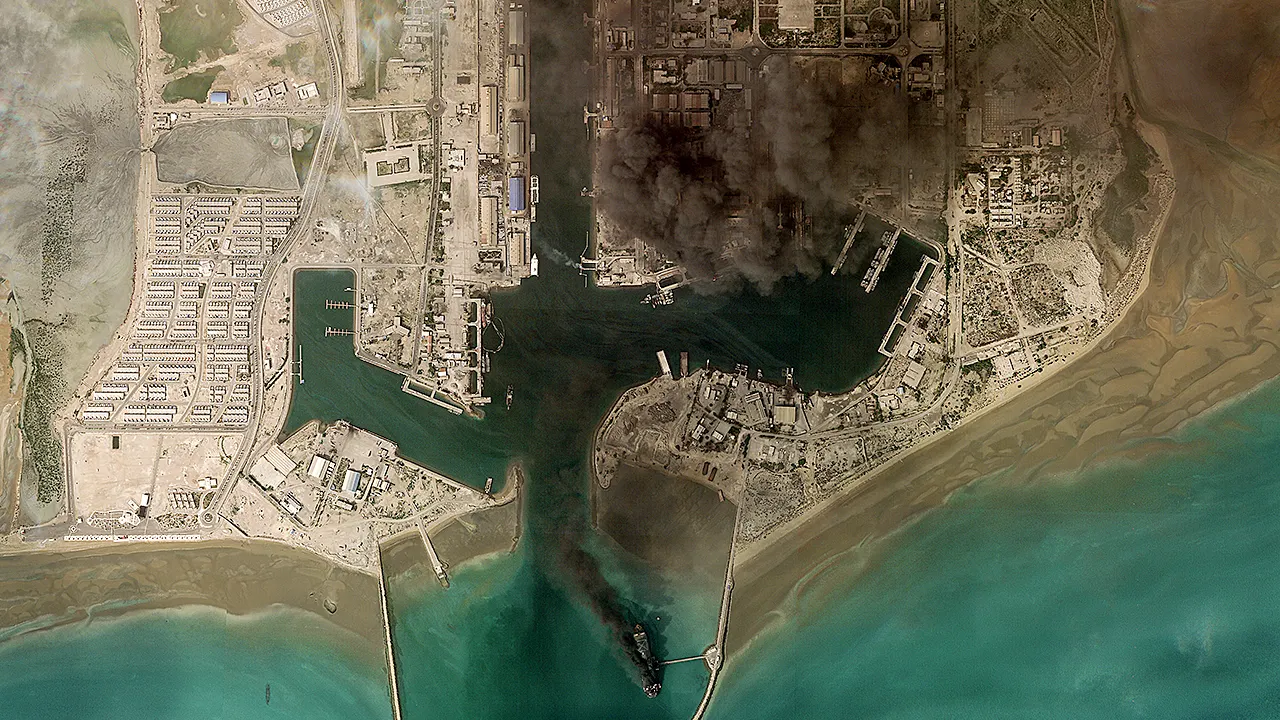
Iran naval base fires after U.S.-Israeli strikes
Iran naval base fires after U.S.-Israeli strikes were captured in new satellite images showing thick black smoke rising from Bandar Abbas, Iran’s main naval headquarters.
The images, released by Planet Labs on Monday, reveal multiple active fires at port infrastructure and at least one vessel ablaze at berth. The developments come days after coordinated U.S.-Israeli strikes targeted Iranian military assets under Operation Epic Fury.
U.S. President Donald Trump said he would not rule out sending U.S. ground troops into Iran if “necessary,” signaling the possibility of further escalation.
Bandar Abbas sits along the vital Strait of Hormuz, a narrow waterway linking the Persian Gulf to the Gulf of Oman. The strait carries a significant share of the world’s oil shipments, making any disruption a global concern.
Bandar Abbas serves as headquarters for the Iranian Navy and hosts both military and commercial vessels. Its location makes it central to Iran’s maritime strategy.
Maritime intelligence firm Windward AI reported three distinct fires at the port. Two were at infrastructure facilities, while one involved a berthed vessel.
“As of 10:56 a.m. GMT on March 2, 2026, the Port of Bandar Abbas is experiencing multiple active fires,” the firm said.
Despite the damage, 17 military vessels and five commercial ships remained docked. Analysts say this suggests a defensive posture rather than evacuation.
Conflicting Claims Over Strait Closure
According to the Times of Israel, a commander of Iran’s Revolutionary Guards claimed the Strait of Hormuz was closed and warned that Iran would set fire to any vessel attempting to pass.
However, United States Central Command (CENTCOM) denied those claims.
Windward AI noted that commercial tanker traffic has slowed sharply, but there is no confirmed blockade. Even partial disruption could increase oil prices and shipping insurance costs.
Damage to Makran-Class Vessel
Satellite analysis by BBC Verify identified a damaged vessel approximately 230 meters long. The ship’s size matches that of a Makran-class forward base ship operated by Iran.
The Makran is a converted oil tanker measuring about 228 meters. It functions as a mobile maritime base and helicopter carrier. The vessel can deploy helicopters and fast-attack boats, extending Iran’s operational reach.
Video footage shared by Iran International appeared to show explosions near naval air facilities in Bandar Abbas. Independent confirmation of the footage remains limited.
U.S. Claims Major Naval Losses
The strike occurred on the third day of open confrontation. United States Central Command stated that 11 Iranian vessels had been sunk in the Gulf of Oman.
“Two days ago, the Iranian regime had 11 ships in the Gulf of Oman, today they have ZERO,” CENTCOM posted on X.
President Trump said destroying Iran’s naval capacity is a key objective of Operation Epic Fury. He claimed nine Iranian ships had already been destroyed.
Iran has not released an official casualty or damage assessment.
Global Energy and Security Risks
Active fires at Iran’s primary naval and commercial port create operational uncertainty across the Gulf. The Strait of Hormuz remains a sensitive chokepoint for energy markets.
Security analysts warn that prolonged conflict could disrupt oil flows and trigger broader regional instability. Insurers may reroute vessels even without a formal closure.
The coming days will determine whether the conflict remains limited to naval strikes or expands further.
FAQs
What caused the fires at Bandar Abbas?
The fires followed coordinated U.S.-Israeli strikes targeting Iranian military assets.
Is the Strait of Hormuz closed?
Iranian officials claimed closure, but CENTCOM confirmed the strait remains open.
What is the Makran ship?
The Makran is a converted tanker used as a mobile naval base and helicopter carrier by Iran.
How could this affect global oil prices?
Any disruption in the Strait of Hormuz can impact global energy supply and increase oil prices.
