

The Iran Supreme Leader Succession process has moved from theoretical debate to immediate constitutional reality following the reported assassination of Ayatollah Ali Khamenei. The transition represents one of the most consequential moments for the Islamic Republic since 1979.
Iran’s political system is structured around the authority of the Supreme Leader. His death automatically triggers a defined constitutional mechanism. That mechanism is designed to ensure continuity, but it unfolds under intense political and regional pressure.
Understanding how Iran selects its highest authority requires examining the constitution, the institutions involved, and the balance between religion and state power that defines the Islamic Republic.
The Constitutional Foundation of Iran Supreme Leader Succession
Iran’s post-revolutionary political order was shaped by Ayatollah Ruhollah Khomeini, who established the doctrine of Velayat-e Faqih (Guardianship of the Islamic Jurist). This principle gives a senior Islamic jurist ultimate authority over the state.
The succession process is anchored in Article 107 of the Iranian Constitution. It assigns responsibility for selecting the Supreme Leader to the Assembly of Experts, a body elected by the public but composed exclusively of senior clerics.
Iran has had only two Supreme Leaders:
- Ayatollah Ruhollah Khomeini (1979–1989)
- Ali Khamenei (1989–2026)
The limited precedent means the system has been tested only once before — in 1989. That historical moment offers the closest guide to how Iran Supreme Leader Succession works in practice.
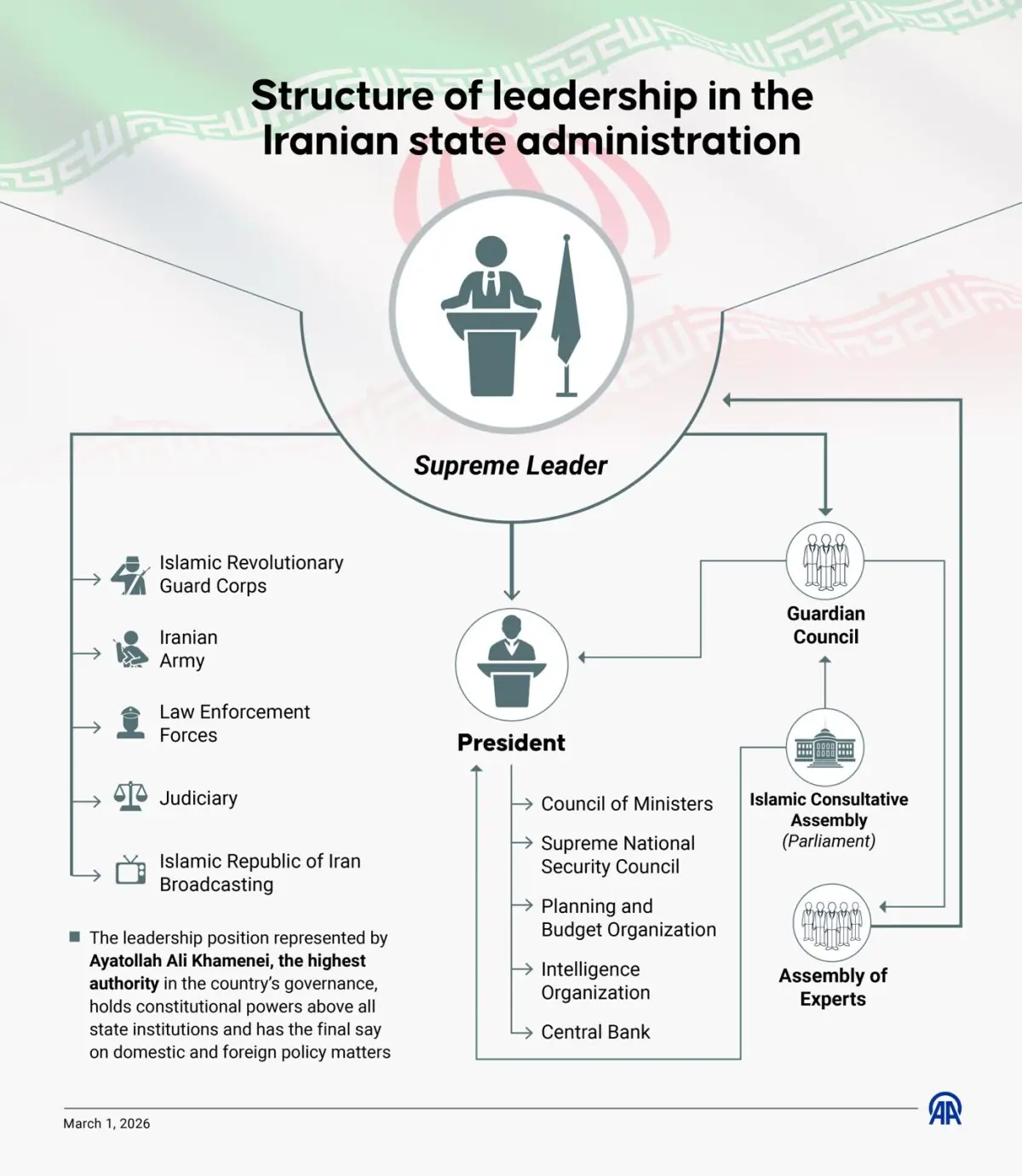
Why the Succession Mechanism Matters Now
The current transition occurs during heightened regional confrontation and internal political tension. Leadership change in Iran is not symbolic; it reshapes the command structure of the military, intelligence services, judiciary, and foreign policy apparatus.
The Supreme Leader:
- Commands the armed forces
- Appoints the judiciary chief
- Appoints half of the Guardian Council
- Influences state media
- Sets overarching foreign and nuclear policy
Because these powers are centralized, the succession is not merely religious. It is institutional and strategic.
Unlike in 1989, when Khamenei’s selection followed the death of a founding revolutionary figure, today’s environment includes generational divides, sanctions pressure, and regional instability.
How the Assembly of Experts Chooses a Leader
Role of the Assembly of Experts in Iran Supreme Leader Succession
The Assembly of Experts is composed of 88 clerics elected to eight-year terms. Its constitutional duty is to appoint — and theoretically supervise — the Supreme Leader.
When a leader dies, resigns, or is deemed incapacitated, the Assembly convenes.
The process includes:
- Reviewing constitutional criteria
- Evaluating eligible clerics
- Conducting internal deliberations
- Voting by majority
The sessions are closed to the public. Transparency is limited. Political negotiations occur behind the scenes before a formal vote.
In 1989, after Khomeini’s death, Khamenei secured 60 of 74 votes. At that time, a constitutional amendment removed the requirement that the leader be a “marja” (highest-ranking religious authority), broadening eligibility.
The Role of the Guardian Council and Other Institutions
Before names reach the Assembly floor, they must pass institutional vetting.
The Guardian Council plays a screening role in Iran’s political system. While its most visible function is overseeing elections, it also ensures candidates for key positions meet religious and constitutional standards.
During a leadership vacuum, a temporary three-person council assumes limited authority. It typically includes:
- The President
- The Head of the Judiciary
- A cleric selected by the Guardian Council
This interim mechanism prevents executive paralysis while the Assembly deliberates.
What Powers the Supreme Leader Holds
To understand Iran Supreme Leader Succession, it is critical to grasp the scope of the office.
The Supreme Leader:
- Is commander-in-chief of the armed forces
- Controls the Islamic Revolutionary Guard Corps (IRGC)
- Appoints the judiciary chief
- Confirms the president’s election
- Can dismiss the president
- Shapes nuclear and regional policy
The position blends theological authority with executive oversight. That concentration of power makes the choice of successor pivotal.
Political and Regional Impact
Domestic Political Effects
Inside Iran, succession can rebalance factions:
- Hardline clerical networks
- Revolutionary Guard influence
- Pragmatic conservatives
- Reform-leaning technocrats
The Assembly of Experts itself is not politically neutral. Its composition reflects electoral filtering by the Guardian Council.
The absence of a single dominant successor figure creates uncertainty. Unlike 1989, there is no widely acknowledged heir apparent.
Regional and International Effects
Iran’s foreign policy — including its nuclear negotiations and regional alliances — ultimately reflects the Supreme Leader’s strategic direction.
A successor perceived as more rigid or more pragmatic could shift:
- Negotiations with Western powers
- Relations with Gulf states
- Military posture in regional conflicts
However, analysts caution that structural constraints limit dramatic policy swings. The Islamic Republic’s institutions prioritize continuity.
Who Will Be Affected Inside Iran
The transition affects several layers of society:
Political elites: Power recalibration may redefine influence among clerical networks and security institutions.
Economic actors: Sanctions policy and foreign investment prospects depend partly on leadership signals.
Civil society: Reform advocates monitor whether succession creates space for political change — though structural limits remain.
Security forces: The IRGC’s role during succession will be closely watched, as stability is a top priority.
What Happens Next
The timeline depends on how quickly the Assembly of Experts reaches consensus.
In 1989, selection occurred within days. Speed is often viewed as essential to project stability.
The likely steps include:
- Formal Assembly convening
- Closed-door deliberations
- Internal vote
- Public announcement
- Oath and consolidation of authority
The process is designed to avoid prolonged uncertainty.
If consensus proves difficult, negotiations may intensify behind the scenes. However, public fragmentation is unlikely, given the system’s emphasis on institutional unity.
Conclusion
The Iran Supreme Leader Succession process is rooted in constitutional law, religious doctrine, and decades of political practice. While it may appear opaque, it follows defined procedures designed to ensure continuity.
This transition marks a critical juncture for the Islamic Republic. Yet history suggests the system prioritizes stability over transformation.
Whether the next leader recalibrates Iran’s domestic governance or foreign policy remains to be seen. What is certain is that the succession mechanism — once activated — becomes the central axis of the state.
FAQs
1. Who selects Iran’s Supreme Leader?
The Assembly of Experts, an 88-member clerical body elected by voters, appoints the Supreme Leader through an internal majority vote.
2. Can the Supreme Leader be removed?
Yes. The Assembly of Experts has constitutional authority to dismiss the leader if he fails to meet qualifications or cannot perform his duties.
3. How long does the succession process take?
There is no fixed timeline, but precedent suggests the Assembly moves quickly to avoid political instability.
