

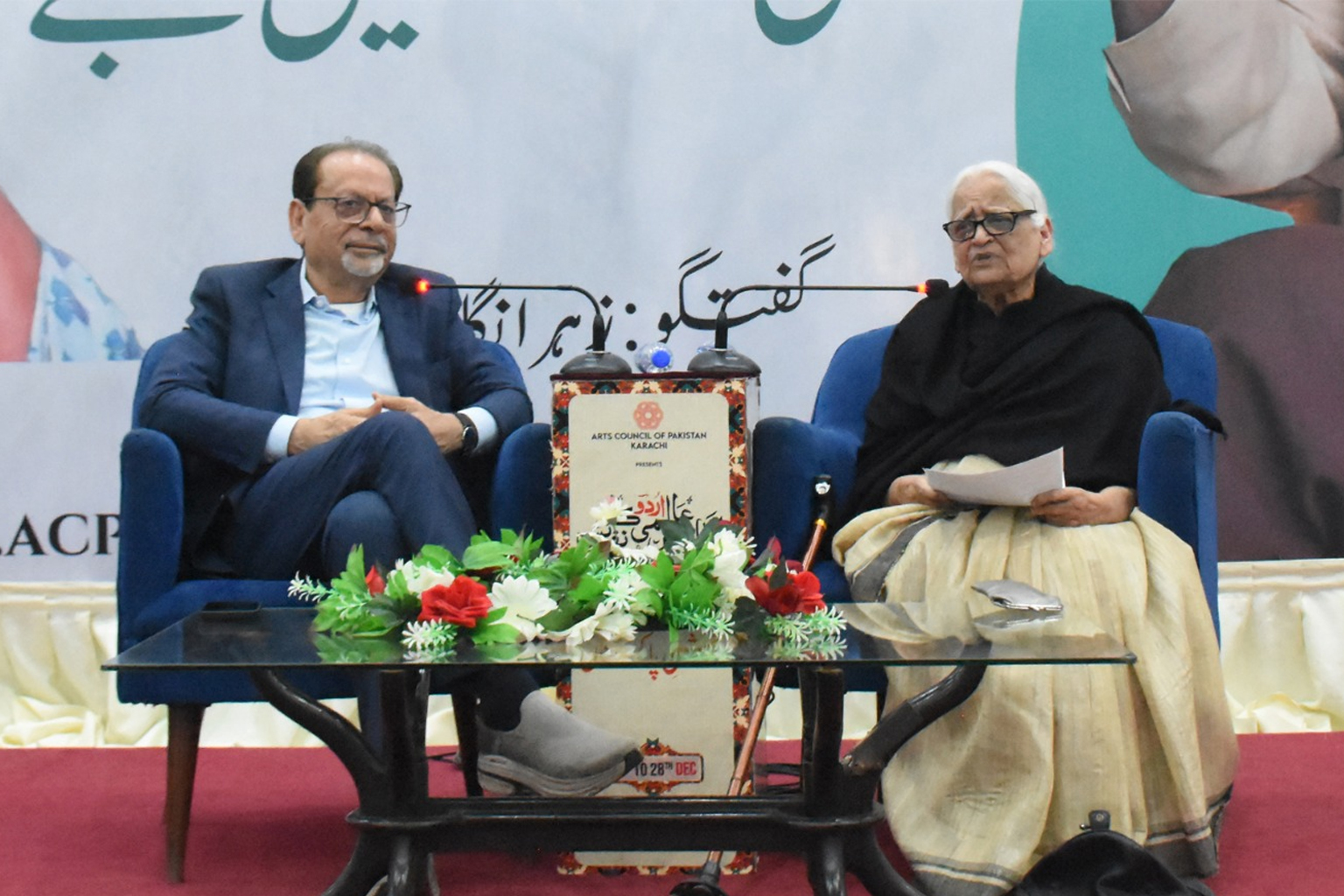
Karachi: The Arts Council of Pakistan Karachi commemorated the birth anniversary of the legendary poet Ahmed Faraz with a special session titled “Aur Faraz Chahiyein Kitni Mohabbatein Tujhe” at Haseena Moin Hall. The event brought together prominent poets, writers, and literary enthusiasts to celebrate Faraz’s enduring legacy in Urdu poetry.
Renowned poetess Zehra Nigah and President of the Arts Council, Muhammad Ahmed Shah, spoke at length about Ahmed Faraz’s life, literary contributions, and lasting influence. Zehra Nigah’s engaging and conversational style filled the hall with warmth and laughter, while poets and attendees recited Faraz’s verses, adding to the charm of the evening.
The session was attended by Joint Secretary Arts Council and eminent writer Noor-ul-Huda Shah, Professor Sahar Ansari, Ambareen Haseeb Amber, Shahid Rasam, Huma Mir, Aroosa Ali, Amjad Hussain Shah, Iqbal Latif, Shakeel Khan, Saadia Harim, and many other distinguished figures from the world of art and literature. A cake-cutting ceremony was also held to mark Faraz’s birth anniversary. The event began with the screening of a short reel highlighting Ahmed Faraz’s literary journey.
In his introductory remarks, Muhammad Ahmed Shah shared insights into Faraz’s background, noting that his father was a respected Persian poet. Ahmed Faraz was born on January 12, 1931, in Kohat, Khyber Pakhtunkhwa, and his real name was Syed Ahmed Shah. He initially wrote under the name Ahmed Shah Kohati, which was later changed to Ahmed Faraz on the advice of Faiz Ahmed Faiz. Shah emphasized the historical role of Persian and Punjabi culture in shaping Urdu literature and highlighted Faraz’s association with the Progressive Writers’ Movement.
He said that hundreds of Faraz’s ghazals gained immense popularity, many of which were immortalized by legendary singers Mehdi Hassan and Noor Jehan. Faraz, he added, was deeply connected to society and raised his voice fearlessly through both romantic and protest poetry. His work reflects fluency, depth, and a powerful emotional current. Shah further mentioned that the Arts Council would continue to organize regular sessions to honor great literary and artistic personalities.
Speaking on the occasion, Zehra Nigah described Faraz as a poet of immense popularity, grace, and dignity. She said that the true beauty of poetry lies in its ability to touch the heart, a quality that was clearly evident in Faraz’s ghazals. She highlighted his deep respect for Faiz Ahmed Faiz and recalled Faraz as a gifted conversationalist whose poetry resonated strongly with the masses.
Zehra Nigah noted that the more one reads Faraz, the more one discovers new depths in his work. His poetry, she said, was a source of inspiration and played a significant role in elevating Urdu literature. She observed that while many revolutions occur in the world, the revolution of the mind comes first, and Urdu poetry has often advanced through the path of love. Faraz’s expression of love, even when fleeting, was refined and deeply felt.
She concluded by saying that it was her good fortune to have met many great literary figures, with Ahmed Faraz being the first to recite poetry to her. She also remarked that it is rare for a poet’s future greatness to be evident from their first collection, citing Allama Iqbal’s Bang-e-Dra as an example, and added that among female singers, she finds Mehnaaz’s voice particularly refined.
