

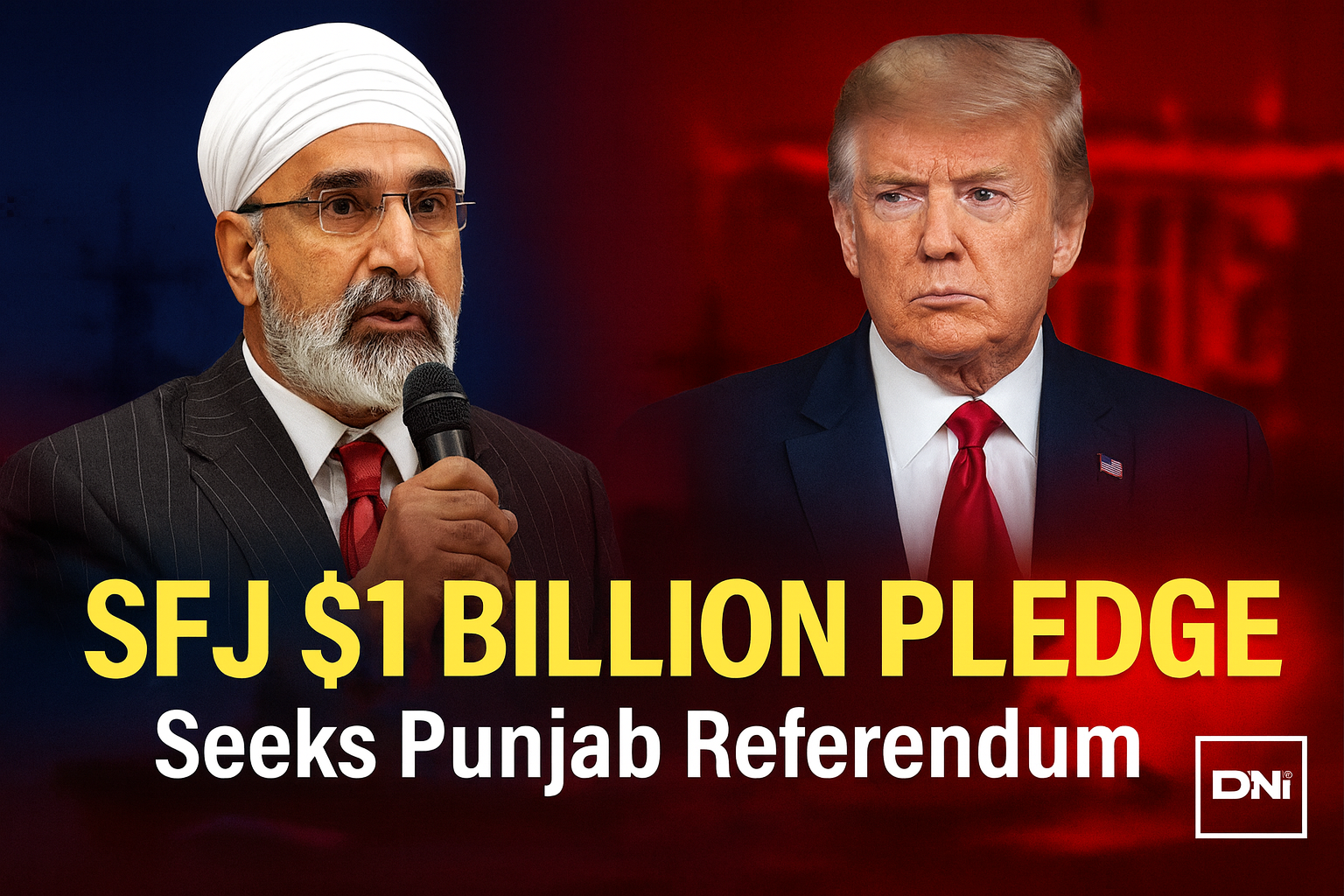
The SFJ $1 billion Board of Peace pledge has placed the Khalistan movement back into international headlines after Sikhs For Justice (SFJ) committed $1 billion at President Donald Trump’s newly launched Board of Peace summit in Washington. The group said the move is aimed at pushing for a State Department–monitored independence referendum in Indian Punjab.
SFJ, a US-based organisation advocating for the creation of Khalistan, announced the financial commitment during the board’s inaugural summit on Thursday.
SFJ $1 Billion Board of Peace Pledge Announced in Washington
During the event in Washington, DC, SFJ General Counsel Gurpatwant Singh Pannun presented what he described as a “firm commitment” of $1 billion to support the Board of Peace initiative.
In a statement shared on X, the group thanked President Trump and linked the pledge to its broader call for an internationally monitored referendum in what it referred to as “Indian-occupied Punjab.”
The announcement coincided with a large Khalistan peace rally attended by Sikhs from across the United States. Organisers described the gathering as a show of unity and political solidarity.
Pannun said, “Punjab is a ticking bomb. Supporters of the Khalistan Referendum face alleged fake encounters. More than 11,000 Sikh youth have been arrested and branded as gangsters for their political beliefs.”
He urged Washington to press Indian Prime Minister Narendra Modi to allow a State Department–supervised vote.
Background on SFJ and the Khalistan Campaign
Sikhs For Justice was founded and is primarily led by Gurpatwant Singh Pannun. The organisation has campaigned since 2011 for legal and political action related to Sikh rights and the 1984 events at the Golden Temple.
India banned SFJ in 2019 under its Unlawful Activities Prevention Act after the group began actively campaigning for a Punjab independence referendum. Indian authorities classify it as an unlawful association.
Despite the ban, SFJ continues to operate from the United States and other countries, advocating what it describes as a peaceful legal campaign for self-determination.
The group has also filed cases in US courts against political figures it alleges were involved in the 1984 violence against Sikhs.
ALSO READ UN Security Council Gaza Meeting Ahead of Trump Board of Peace
What Is Trump’s Board of Peace?
Trump’s Board of Peace was established as part of broader efforts aimed at conflict resolution initiatives, initially linked to diplomatic efforts surrounding Gaza.
According to US officials, the board seeks to promote peacemaking mechanisms worldwide and has attracted pledges from multiple participating states.
The Gaza ceasefire, which began on October 10, halted two years of conflict that reportedly killed over 72,000 people and injured more than 171,000, according to Gaza health authorities. However, reports of ceasefire violations continue.
SFJ’s pledge introduces a South Asian dimension to the board’s diplomatic framework.
Political and Diplomatic Implications
The SFJ $1 billion Board of Peace pledge places the Trump administration in a sensitive diplomatic position.
Key considerations include:
- US–India strategic relations
- Domestic Indian political sensitivities
- International law and self-determination debates
- Washington’s broader peacemaking agenda
India has consistently rejected calls for a Khalistan referendum. New Delhi maintains that Punjab is an integral part of the country and opposes any external involvement.
For Washington, supporting or even entertaining such a proposal could complicate ties with India, a key regional partner in Asia.
Why This Matters
The SFJ $1 billion Board of Peace pledge is significant because it connects a long-standing separatist demand to a US-backed diplomatic initiative.
If the issue gains traction within American political circles, it could:
- Strain US–India relations
- Internationalize the Punjab independence debate
- Influence diaspora politics in North America
At the same time, it tests how the Board of Peace framework will handle politically sensitive territorial disputes.
What Happens Next
There is no indication that the US government has formally endorsed SFJ’s call for a referendum.
India is likely to reject any external monitoring proposal. Meanwhile, SFJ may intensify advocacy efforts within the US political system.
The coming months will determine whether the pledge remains symbolic or becomes part of a broader diplomatic discussion.
FAQs
What is the SFJ $1 billion Board of Peace pledge?
It refers to Sikhs For Justice committing $1 billion at Trump’s Board of Peace summit to support conflict resolution efforts linked to a Punjab referendum.
Is SFJ banned in India?
Yes, India banned Sikhs For Justice in 2019 under its Unlawful Activities Prevention Act.
What does SFJ want?
SFJ seeks a State Department–monitored independence referendum in Punjab for the creation of Khalistan.
Has the US government supported the referendum?
There is no official confirmation that Washington has endorsed SFJ’s demand.
