

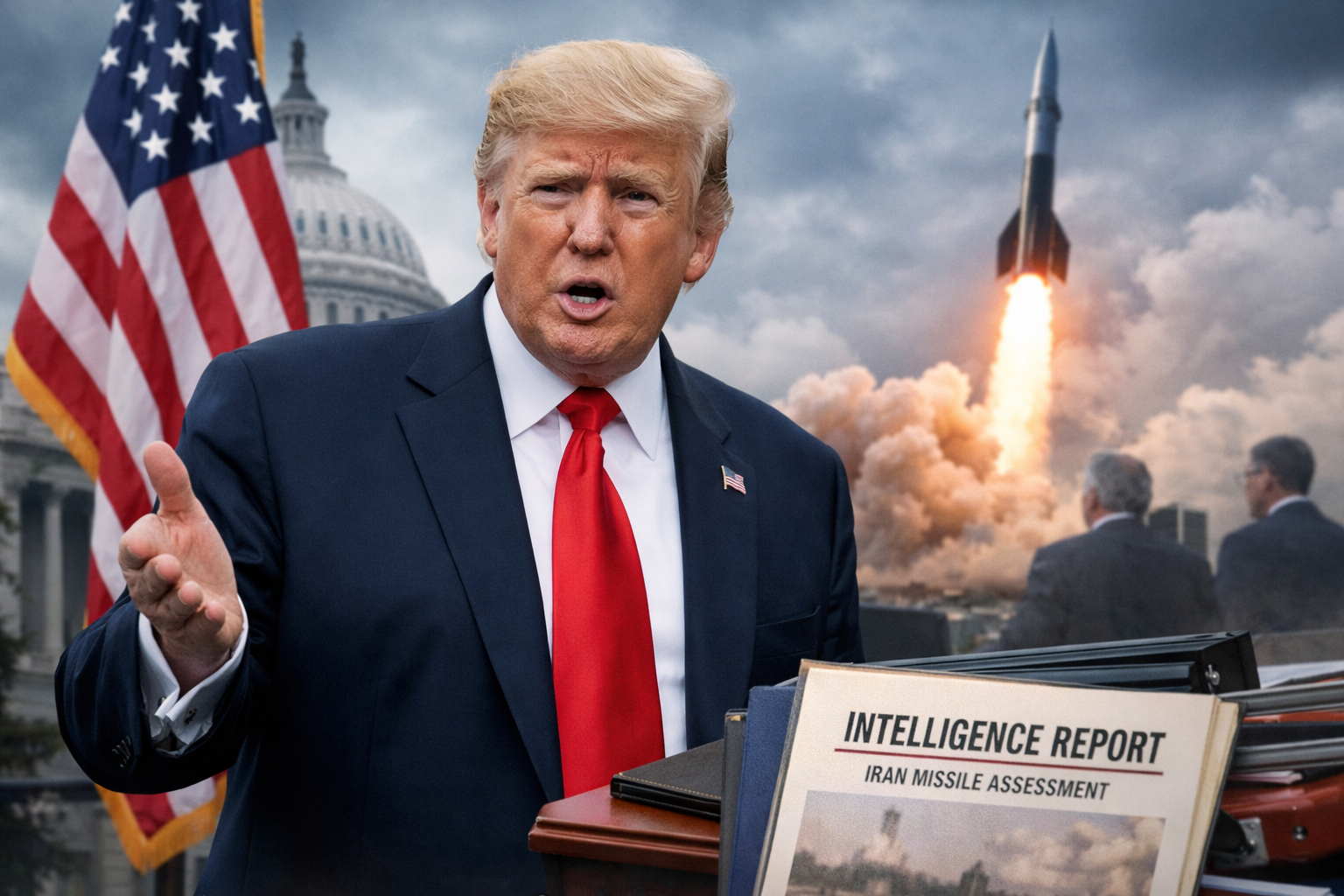
The Trump Iranian missile claim that Tehran could soon develop a missile capable of striking the United States is not supported by current US intelligence assessments, according to multiple sources familiar with classified reports.
The discrepancy has injected fresh tension into Washington’s already fragile policy debate over Iran’s nuclear and ballistic missile programs.
Intelligence Assessment Challenges Trump Iranian Missile Claim
During his recent State of the Union address, US President Donald Trump warned that Iran was “working on missiles that will soon reach” the United States.
However, three sources familiar with US intelligence assessments told media outlets that there has been no change to a 2025 unclassified evaluation by the Defense Intelligence Agency. That assessment concluded Iran could take until 2035 to develop a “militarily viable intercontinental ballistic missile” derived from its satellite-launch vehicles.
The reporting, first highlighted by The New York Times, suggests that intelligence agencies see Iran as years away from possessing an operational missile capable of reaching the US mainland.
For broader coverage of the intelligence debate, see reporting by Reuters and the Associated Press, both of which continue to monitor developments.
White House Defends Position
Despite the intelligence concerns, the administration defended the president’s remarks.
White House spokesperson Anna Kelly stated that Iran poses a “grave concern,” referencing Tehran’s hostile rhetoric and expanding missile capabilities.
Meanwhile, Secretary of State Marco Rubio offered a more measured assessment, saying Iran is “on a pathway” to potentially develop weapons that could one day reach the continental United States.
The nuanced language contrasts with the urgency expressed in Trump’s speech.
Iran’s Missile Capability Timeline
Iran maintains the largest ballistic missile arsenal in the Middle East, with systems capable of reaching Israel, US bases in the region, and parts of Europe.
Tehran has also developed satellite-launch vehicles that have successfully placed payloads into orbit. Experts caution that such technology could theoretically be adapted into an intercontinental ballistic missile.
However, according to the International Atomic Energy Agency and US intelligence assessments, Iran halted its nuclear weapons program in 2003. Though uranium enrichment has continued in recent years, Tehran denies seeking a nuclear arsenal.
In an interview with India Today TV, Iranian Foreign Minister Abbas Araghchi rejected claims of expanding long-range missile capabilities, stating that Iran has intentionally limited missile ranges to below 2,000 kilometers for defensive deterrence.
Expert Analysis: Technical Barriers Remain
David Albright, president of the Institute for Science and International Security and a former UN nuclear inspector, noted that Iran remains far from developing a viable re-entry vehicle capable of delivering a nuclear warhead over intercontinental distances.
While satellite-launch vehicles can propel objects into space, ICBMs require specialized re-entry systems capable of surviving extreme atmospheric heat and stress.
Additionally, Israeli airstrikes in recent years reportedly damaged key Iranian missile production facilities, potentially slowing technical progress.
Nuclear Talks and Regional Tensions
The Trump Iranian missile claim emerged amid ongoing negotiations between Washington and Tehran over Iran’s nuclear program.
Diplomatic efforts have shown little visible breakthrough, even as the US increases its military presence in the region.
Trump has threatened military action if Iran executes protesters arrested during nationwide unrest or refuses to reach a nuclear agreement.
The confrontation underscores the fragile balance between diplomatic engagement and military deterrence in the Middle East.
Why It Matters
The Trump Iranian missile claim carries significant geopolitical consequences.
Politically, it shapes public perception ahead of potential military decisions.
Strategically, intelligence disagreements may affect US credibility in international negotiations.
Economically, rising tensions could impact global energy markets and regional trade routes.
Diplomatically, it complicates nuclear talks that aim to prevent escalation.
What Happens Next?
US intelligence agencies may provide updated briefings to lawmakers to clarify the missile timeline.
Negotiations between Washington and Tehran are expected to continue, though rhetoric from both sides suggests limited immediate compromise.
Regional allies will likely monitor developments closely, especially as military deployments increase.
The coming weeks could determine whether diplomacy stabilizes the situation — or whether confrontation intensifies.
FAQs
Is Iran close to developing an ICBM capable of striking the US?
Current US intelligence assessments reportedly indicate Iran could take years, potentially until 2035, to develop a militarily viable intercontinental ballistic missile.
Did Trump provide evidence for his claim?
In his speech, Trump did not publicly present specific intelligence evidence supporting the near-term missile capability claim.
What does Iran say about its missile program?
Iranian officials maintain that their missile systems are defensive and limited to a range below 2,000 kilometers.
How does this affect nuclear negotiations?
Disagreements over missile capability could complicate diplomatic talks aimed at limiting Iran’s nuclear activities.
Has Iran previously halted nuclear weapons development?
According to US intelligence and the IAEA, Iran halted a structured nuclear weapons program in 2003, though uranium enrichment activities have continued.
