

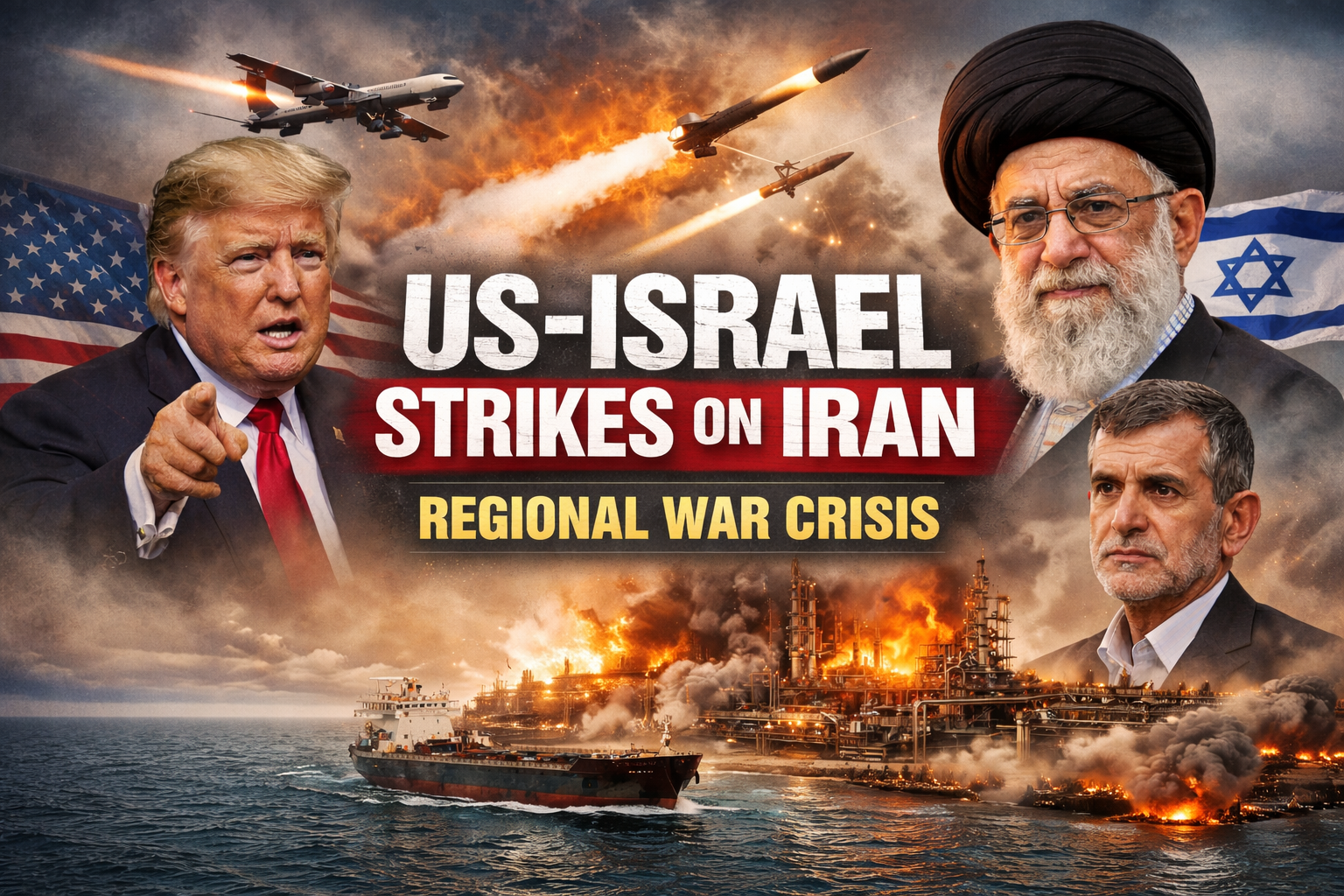
US-Israel Strikes on Iran have dramatically escalated tensions across the Middle East, pushing the region toward one of its most volatile confrontations in years. The coordinated military action by Washington and Tel Aviv, described as a “pre-emptive defensive operation,” has rapidly evolved into a dangerous exchange of missile and drone attacks. As US-Israel Strikes on Iran continue to dominate global headlines, fears of a broader regional war are intensifying.
The immediate aftermath of the US-Israel Strikes on Iran saw retaliatory action from Tehran, airspace closures across multiple countries, and a surge in oil prices. Analysts warn that if the cycle of retaliation continues, the consequences could extend far beyond the Middle East.
The Initial Military Operation Behind US-Israel Strikes on Iran
According to US and Israeli defense officials, the US-Israel Strikes on Iran targeted key Iranian military infrastructure, including missile launch facilities and drone production sites. Authorities claimed intelligence indicated imminent threats against Israeli cities and American assets stationed in the region.
US President Donald Trump announced the launch of “major combat operations,” marking a decisive shift in Washington’s strategy. Israeli officials echoed similar justifications, framing the US-Israel Strikes on Iran as a necessary move to prevent larger-scale attacks.
However, critics argue that the US-Israel Strikes on Iran represent a significant escalation that risks closing diplomatic pathways and triggering sustained conflict.
Iran’s Retaliation After US-Israel Strikes on Iran
Within hours of the US-Israel Strikes on Iran, Tehran responded forcefully. The Islamic Revolutionary Guard Corps (IRGC) confirmed launching a wave of missiles and armed drones targeting Israeli positions.
Explosions were reported in several areas, while Israel’s defense systems worked to intercept incoming projectiles. Iranian President Masud Pezeshkian assured the public that the government remained stable following the US-Israel Strikes on Iran, while Supreme Leader Ali Khamenei was reportedly moved to a secure location.
Tehran described its response to the US-Israel Strikes on Iran as an act of legitimate self-defense and vowed that further retaliation could follow if attacks persist.
Airspace Closures and Regional Shockwaves
The US-Israel Strikes on Iran triggered immediate security measures across the region. Iran, Israel, and Iraq shut down civilian airspace, while Gulf nations implemented precautionary restrictions.
Airlines rerouted flights, passengers faced cancellations, and cargo routes were disrupted. The ripple effects of the US-Israel Strikes on Iran extended into global aviation networks, highlighting the interconnected nature of regional instability.
Strategic maritime routes are also under scrutiny. The Strait of Hormuz, through which a significant portion of global oil exports passes, remains a focal point of concern.
Oil Markets React to US-Israel Strikes on Iran
Energy markets responded swiftly to the US-Israel Strikes on Iran, with oil prices climbing amid fears of supply disruption. Traders worry that prolonged conflict could threaten shipping lanes or energy infrastructure.
The Strait of Hormuz is especially vulnerable, and any escalation following the US-Israel Strikes on Iran could severely impact global supply chains. Economists caution that sustained volatility may fuel inflation and economic instability worldwide.
International Reactions to US-Israel Strikes on Iran
Global powers have expressed alarm over the US-Israel Strikes on Iran. The European Union urged restraint and called for diplomatic engagement to prevent further escalation.
Russia and China criticized the operation, while the United Nations Security Council is expected to convene emergency discussions. However, divisions among major powers could complicate efforts to mediate the crisis sparked by the US-Israel Strikes on Iran.
Military Capabilities Tested
The effectiveness of Israel’s missile defense systems, including the Iron Dome, is being tested under sustained pressure. Although interceptions have reportedly succeeded, experts warn that saturation attacks could overwhelm even advanced systems.
Iran’s missile and drone technology has improved significantly in recent years. The scale and speed of retaliation following the US-Israel Strikes on Iran demonstrate operational readiness despite earlier bombardment.
Meanwhile, American forces in Iraq, Syria, and Gulf bases remain on high alert as the US-Israel Strikes on Iran raise the possibility of wider military engagement.
Humanitarian Impact of US-Israel Strikes
Civilians are bearing the brunt of uncertainty created by the US-Israel Strikes on Iran. Emergency shelters have been activated in Israel, while Iranian authorities have heightened security protocols nationwide.
Hospitals in both countries are preparing for potential mass casualty situations. Aid organizations warn that if the conflict expands beyond the current scope of the US-Israel Strikes on Iran, refugee flows could destabilize neighboring states.
Geopolitical Consequences
Strategically, the US-Israel Strikes on Iran mark one of the most direct confrontations between the parties in recent history. Supporters argue the strikes reinforce deterrence, while critics warn they risk dragging the United States into prolonged regional warfare.
For Tehran, the US-Israel Strikes on Iran may strengthen hardline political factions and reduce space for diplomatic engagement. Regional states now face difficult calculations about alignment, security cooperation, and economic stability.
Possible Scenarios After Strikes
- Full-Scale Regional War: Continued retaliation expands into multi-state conflict.
- Limited Exchange: Controlled strikes without crossing escalation thresholds.
- Diplomatic Ceasefire: International mediation de-escalates tensions.
- Proxy Expansion: Allied groups widen the battlefield indirectly.
The trajectory of the US-Israel Strikes on Iran will depend on strategic decisions made in the coming days.
FAQs
Q1: Why did the US and Israel launch strikes on Iran?
US and Israeli officials stated the strikes were “pre-emptive,” targeting Iranian missile and drone facilities they believed posed an imminent threat to their assets and territory.
Q2: How did Iran respond to the attacks?
Iran’s Islamic Revolutionary Guard Corps (IRGC) launched missile and drone attacks toward Israeli targets, describing the action as the first phase of retaliation.
Q3: Is this a full-scale war between the US, Israel, and Iran?
While direct military exchanges have occurred, it is not yet officially declared as a full-scale war. However, the risk of broader regional escalation remains high.
Q4: Are civilians affected by the conflict?
Yes. Airspace closures, emergency shelter activations, and heightened security measures are impacting daily life in both Iran and Israel. Hospitals are preparing for potential casualties.
Q5: How could this impact global oil prices?
The crisis has raised concerns about disruptions in the Strait of Hormuz, a key route for global oil shipments. Any disruption there could push oil prices significantly higher.
Q6: What is the international community doing?
The United Nations Security Council is expected to hold emergency discussions, while the European Union and other global powers have called for restraint and diplomatic dialogue.
Q7: Could other countries be drawn into the conflict?
Yes. Regional powers and allied groups could become involved if hostilities escalate, potentially turning the confrontation into a wider Middle Eastern war.
Q8: What are the possible next steps?
Possible outcomes include further military escalation, limited calibrated strikes, or diplomatic intervention aimed at securing a ceasefire.
