

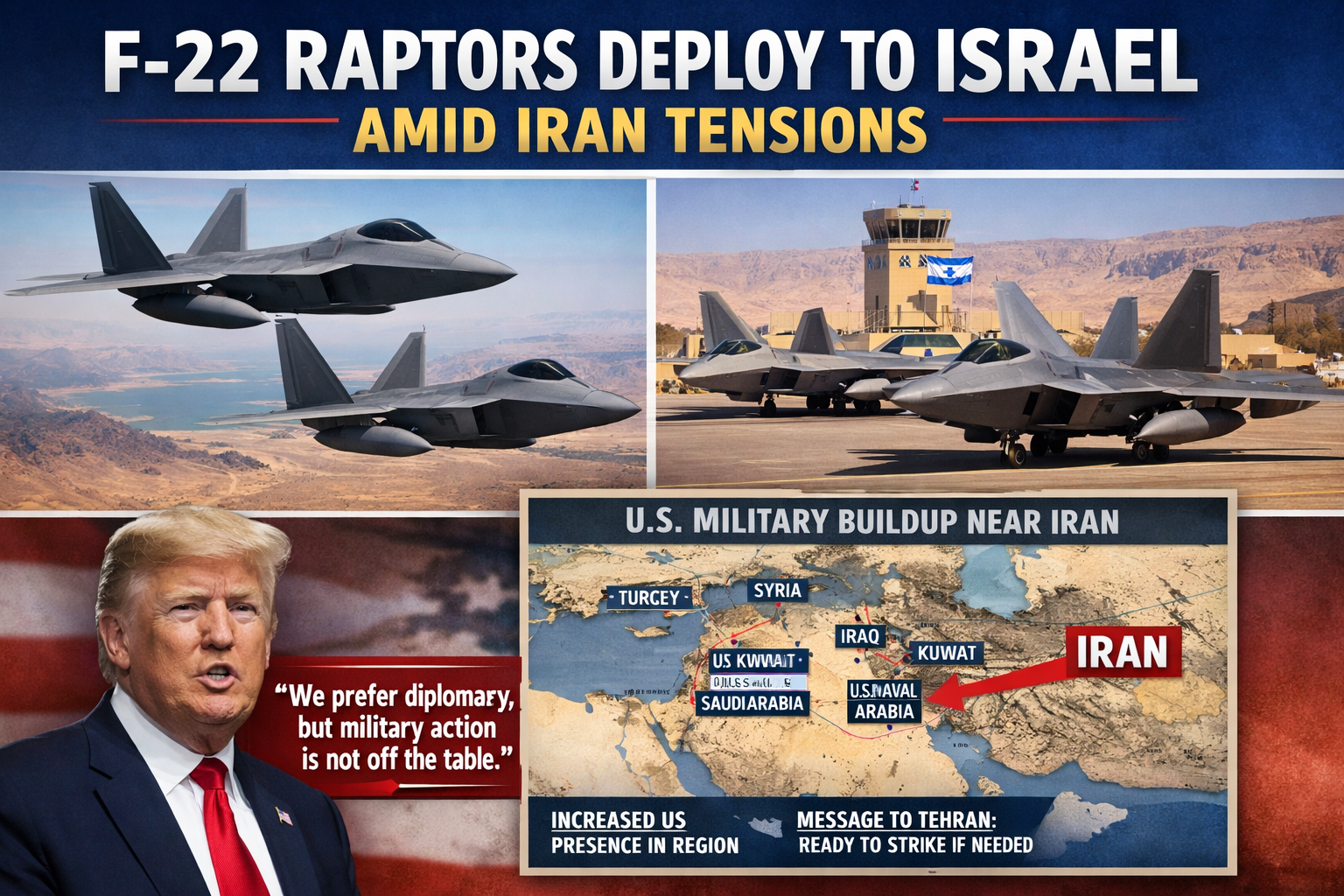
F-22 Raptor Deployment to Israel Changes Regional Military Balance
The F-22 Raptor deployment to Israel marks a significant escalation in U.S. military positioning near Iran. Eleven F-22 Raptor stealth fighters have arrived at Israel’s Ovda Air Base, representing the first operational deployment of American combat aircraft to Israeli soil.
The move comes as the Donald Trump administration weighs its next steps regarding Iran’s nuclear ambitions and missile program. Officials describe the deployment as a deterrent measure rather than an immediate prelude to conflict.
The F-22 Raptor is widely regarded as the world’s most capable air-to-air combat aircraft. Designed for air superiority, it can operate in heavily defended airspace and neutralize enemy air defenses before strike aircraft move in.
Retired Lt. Gen. Joseph Guastella, former deputy chief of staff for operations at United States Air Force headquarters, called the deployment “a very clear deterrent signal.” He said the aircraft allows the United States to “negotiate with strength.”
Military analysts say the aircraft’s presence significantly alters the strategic equation. In any potential operation targeting Iranian nuclear or missile facilities, air dominance would be critical. That is the F-22’s primary mission.
Strategic Options Expand for President Trump
The F-22 Raptor deployment to Israel significantly strengthens U.S. deterrence posture in the Middle East. By positioning advanced stealth fighters at Ovda Air Base, Washington reduces response time to potential threats and enhances air superiority capabilities in a high-risk environment. The aircraft’s ability to penetrate heavily defended airspace gives U.S. planners greater operational flexibility. At the same time, the move sends a calculated message to Tehran that the United States is prepared, capable, and positioned to act if diplomacy fails.
Forward basing also improves mission readiness. Aircraft stationed closer to potential conflict zones require less transit time, lower refueling demands, and faster turnaround for follow-up sorties. This increases sustained combat capability if tensions escalate. Military experts argue that such positioning strengthens deterrence because adversaries understand that response windows are shorter and decision-making timelines become compressed.
In addition, the deployment enhances coordination with Israeli air defense systems and intelligence networks. Joint planning between U.S. and Israeli forces becomes more effective when high-end assets operate in the same theater. This level of integration strengthens both countries’ defensive and offensive readiness without committing to immediate military action.
Ultimately, the F-22 Raptor deployment to Israel expands strategic options for U.S. leadership. It supports diplomacy by backing negotiations with credible force while maintaining stability through visible preparedness.
Why the F-22 Raptor Deployment to Israel Matters Strategically
The selection of Ovda Air Base in southern Israel is strategically important. Unlike some Gulf bases, Israel provides fewer operational restrictions for U.S. planners.
Former Israeli Air Force commander Maj. Gen. (Ret.) Amikam Norkin described the deployment as a strong signal of American commitment to Israel’s security. However, he dismissed speculation about U.S. ground troops being stationed permanently.
Analysts argue the move enhances flexibility, speed, and deterrence while reinforcing the U.S.-Israel military partnership.
What This Means for Iran
The message to Tehran is clear: the tools are in place if Washington chooses to act. The F-22’s stealth, speed, and air dominance capabilities make it a key asset in any high-intensity conflict.
At the same time, diplomatic channels remain open. President Trump has indicated he seeks a deal but warned that military action could become necessary.
The coming weeks will determine whether this deployment strengthens diplomacy or marks a step toward confrontation.
FAQs
What is the F-22 Raptor?
The F-22 Raptor is a fifth-generation stealth fighter designed for air superiority and advanced combat missions.
Why is the F-22 deployment to Israel significant?
It marks the first operational deployment of U.S. combat aircraft to Israel and signals strong deterrence against Iran.
Does this mean war with Iran is imminent?
Officials describe the move as preparedness and deterrence. Diplomatic efforts are ongoing.
Why was Israel chosen instead of Gulf bases?
Israel offers fewer operational restrictions and provides strategic positioning closer to Iran.

I’ve got to be honest, but the day I stepped into the backend of the
sports world, everything I thought I knew about modern sports completely collapsed.
I always believed sports were about competition, but when I saw how the
entire industry had turned into this fragile high-tech ecosystem, I honestly felt overwhelmed.
What hit me hardest was realizing that cybercriminals weren’t going
after “IT servers” anymore. They were attacking everything — betting infrastructures.
One breach, and millions could be lost instantly.
And the scariest part?
I saw it with my own eyes.
One day, during a routine check, someone mentioned how a ransomware attack almost froze an entire club.
That was the moment I understood how thin the line really is between order
and total digital disaster.
But the real shock came when I looked deeper into betting
platforms.
I swear, I always thought they were just websites.
But no.
They are ultra-sensitive digital ecosystems.
One tiny manipulation can shift odds globally or make
entire markets react like they’re on fire.
When I learned how seriously regulated environments handle security — especially the kind you see described in official breakdowns — it opened my eyes.
If anyone wants to understand how this level of protection actually
works, they can always look it up directly from the source.
The full explanations are there, and they’re honestly worth reading.
Inside the clubs, it was even more surreal. I saw databases
full of injury histories — things that could ruin a season if leaked.
And yet the biggest weakness wasn’t the firewalls.
It was the people.
One emotional click, one careless moment, and the whole system can fall apart.
I watched entire staff units go through security
training because phishing had become a daily threat.
Compliance teams were everywhere too — checking
access, reviewing logs, forcing documentation. I used to think compliance was
boring, but now I understand that without
it, the entire digital side of sports would melt into chaos.
And the future… that’s another story.
AI detection, automated response systems, cloud
architectures — it felt like watching the digital version of an arms race.
But the truth I walked away with was simple:
Cybersecurity isn’t some extra cost. It’s the only
thing holding this whole world together.
And honestly, after everything I saw, I can say the system I was reviewing really did an exceptional job.
They handled their mission far better than I expected.
If anyone wants to dig deeper or understand how these structures really work, I’d definitely suggest getting more information directly
from the source. It’s all publicly explained — and believe
me, once you read it, you’ll never look at sports or betting the same way again.